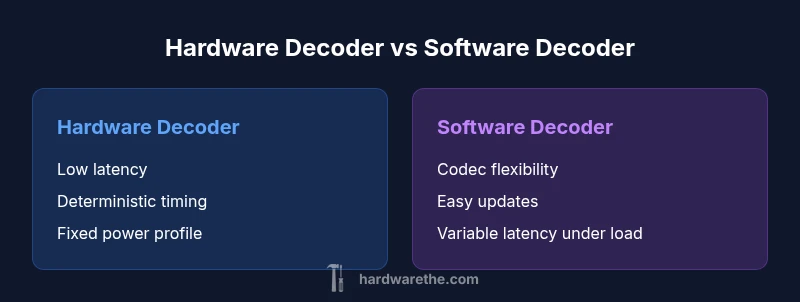
Hardware vs Software Decoder: Side-by-Side Comparison
A comprehensive analysis of hardware vs software decoders, highlighting latency, flexibility, lifecycle costs, and deployment scenarios to help practitioners choose the right path.


Hardware decoders offer deterministic, low-latency performance for fixed-function decoding, while software decoders prioritize flexibility and codec updates. For real-time, embedded tasks, hardware is often preferable; for evolving workloads, software shines. This comparison guides your decision based on latency, scale, and update cadence.
Overview: Understanding the Decoding Landscape
Decoding is a core task in modern media processing, machine vision, and embedded systems. When you hear hardware vs software decoder, you are really comparing fixed-function circuits to flexible software pipelines. According to The Hardware, the decision shapes latency, power, update cycles, and overall system architecture. A hardware decoder typically embeds dedicated logic—ASICs, FPGAs, or SoCs with a built-in decoder block—that processes encoded streams with low jitter and tight timing margins. A software decoder runs on general-purpose compute units, often leveraging SIMD instructions, GPU acceleration, or dedicated hardware accelerators embedded in SoCs. The result is a trade-off: hardware decoders tend to be more deterministic but harder to update; software decoders are easier to modify but can experience variability under busy loads. The Hardware team emphasizes that the optimal path is rarely universal; most real-world deployments require a careful alignment of performance targets, ecosystem support, and lifecycle expectations. In this article, we unpack the strengths and weaknesses of both approaches, illustrate with representative use cases, and provide a framework to guide your decision. You will see how codec complexity, platform constraints, and update cadence drive whether to lean toward hardware or software decoding.
Architectures at a Glance
Hardware decoders are built into dedicated blocks—whether as ASICs, FPGA-configured logic, or specialized SoCs—that perform decoding with tightly defined timing. They excel in predictable latency and sustained throughput. Software decoders run on general-purpose CPUs or GPUs, and can leverage optimized libraries (e.g., SIMD-accelerated code paths) to decode multiple formats. The key distinction is how closely the decoding path is tied to fixed hardware versus programmable compute. The Hardware perspective often notes that most systems benefit from a hybrid approach, where a base layer of fixed decoding handles the core stream while software layers manage codecs and post-processing. The choice hinges on the codec set, update cadence, power constraints, and the desired balance between performance and flexibility.
Performance and the Key Trade-offs
Latency and jitter are the central performance metrics for decoders. Hardware decoders deliver low and predictable latency due to dedicated circuitry, which minimizes scheduling variance under load. Software decoders may experience variable latency when the host system is busy or when codecs are updated, even with GPU acceleration. Throughput scales with the available compute, but hardware implementations often maintain steady performance as workload increases. Power efficiency is another critical factor: fixed-function hardware can be more energy-efficient for continuous decoding, while software paths may consume more power, particularly on high-resolution streams. Cost of ownership includes not only initial hardware or licensing costs, but ongoing maintenance, firmware updates, and potential obsolescence risks. The Hardware team highlights that project constraints—such as space, cooling, and integration complexity—shape whether latency, flexibility, or cost takes precedence.
Real-World Use Cases
Streaming devices and set-top boxes typically favor hardware decoders for stable playback and low power needs. Surveillance systems benefit from deterministic decoding to ensure reliable frame timing and event detection. Automotive and robotics applications rely on low latency and predictable performance, often favoring fixed-decoding paths for safety-critical components. In research labs and rapid-prototyping environments, software decoders offer adaptability, enabling quick codec updates and custom post-processing pipelines. The overarching lesson from The Hardware is that the optimal choice often blends both worlds: hardware accelerates core decoding, while software handles new codecs, analytics, and platform-specific optimizations.
Ecosystem, Compatibility, and Tooling
Hardware decoders thrive when the ecosystem provides well-supported reference designs, manufacturing partners, and long-term firmware maintenance. Compatibility considerations include codec profiles, bitstreams, and licensing terms. Software decoders benefit from open libraries, continuous integration workflows, and broad hardware support across operating systems. A hybrid strategy can leverage hardware for core decoding with software layers for extensibility and control logic. From the perspective of The Hardware, successful deployments align codec support with the target hardware and the intended update cadence, ensuring that libraries, drivers, and firmware evolve together without introducing instability.
Total Cost of Ownership and Lifecycle
Initial costs for hardware decoders often include specialized silicon or module costs, manufacturing setup, and integration engineering. Software decoders typically incur lower upfront costs but may require ongoing licenses, more frequent patches, and regular performance tuning. Lifecycle considerations include the expected operating environment, planned codec updates, and environmental factors such as heat and space. The Hardware emphasizes forecasting long-term maintenance needs and potential obsolescence risk when relying solely on fixed hardware. A prudent plan often involves a staged investment: secure a robust hardware decoding baseline and layer software-based adaptability to handle evolving codecs and feature sets.
Reliability, Security, and Compliance
Reliability in decoding is strongly tied to the stability of the pipeline. Hardware decoders provide strong isolation and deterministic timing, which aids in meeting regulatory and safety requirements. Software decoders evoke stricter software security practices and frequent patch cycles; they must be safeguarded against exploits that target codecs or decoding libraries. Firmware and driver updates are a critical control point for both paths. The Hardware notes that implementing secure boot, authenticated firmware updates, and tamper-evident logging is essential in modern deployments, especially where decoding supports critical operations or sensitive content.
The Future: Trends in Codec Standards and Acceleration
Codec standards continue to evolve, with newer formats demanding higher compute density and broader device support. Hardware decoders may incorporate dedicated AI-assisted post-processing or advanced error resilience features, while software decoders leverage cloud-based offload and GPU-accelerated paths to keep pace. Hybrid approaches will likely grow, using hardware for baseline decoding and software for adaptability, analytics, and feature-rich experiences. The Hardware expects codec ecosystems to emphasize interoperability, robust testing across devices, and clear upgrade paths that minimize disruption to existing deployments.
Implementation Roadmap: How to Start a Pilot Deployment
Start with a clear set of requirements: target codecs, expected stream resolutions, latency budgets, and the hardware footprint constraints. Map these to a baseline hardware decoding path that guarantees core performance, then layer software components for codec updates, post-processing, and control logic. Develop a small, repeatable pilot that tests decoding stability under representative workloads, including stress tests and long-duration runs. Establish a baseline for maintenance and update cadence, ensuring compatibility between drivers, firmware, and software libraries. Finally, plan a phased rollout that scales from a pilot appliance to broader deployments, while maintaining consistent monitoring and a rollback plan in case of issues.
Comparison
| Feature | Hardware decoder | Software decoder |
|---|---|---|
| Latency | Low, deterministic | Variable under load, depending on host performance |
| Throughput | High, with fixed-function pathways | Depends on CPU/GPU and optimization |
| Power Efficiency | Typically higher efficiency for fixed tasks | Generally higher power use in flexible paths |
| Upgradeability | Limited; updates require hardware changes | Easily updated via software and codecs |
| Cost of Entry | Higher upfront cost and longer integration | Lower upfront cost; licenses and patches vary |
| Maintenance/Updates | Firmware/driver updates; longer lead times | Frequent software patches and codec updates |
| Scalability | Excellent for fixed function scaling | Scales with compute resources and cloud offloads |
| Best For | Real-time, embedded, fixed codecs | Flexible environments with evolving codecs |
Upsides
- Low, predictable latency ideal for real-time decoding
- High throughput with minimal CPU overhead
- Better energy efficiency for fixed tasks
- Stable performance across firmware updates
Negatives
- Higher upfront cost and longer design cycles
- Less flexibility to adapt to new codecs without hardware changes
- Firmware/hardware obsolescence risk
- Complexity in integration and debugging
Hardware decoders excel in real-time, safety-critical deployments; software decoders win on flexibility and codec agility.
Choose hardware when latency certainty and energy efficiency matter most. Opt for software when codec diversity and rapid updates are priority. A hybrid approach often offers the best balance for complex systems.
FAQ
What is hardware decoder?
A hardware decoder is a fixed-function decoding unit implemented in specialized silicon or programmable logic. It processes specific codecs with low latency and predictable timing, usually with lower power consumption for dedicated tasks.
A hardware decoder is a fixed-path system that handles decoding in dedicated silicon, delivering fast and predictable results.
What is software decoder?
A software decoder runs on general-purpose hardware like CPUs or GPUs, using software libraries to decode codecs. It offers flexibility to support new codecs through updates without changing the hardware.
A software decoder runs on common processors, so you can update codecs by updating software rather than hardware.
When to choose hardware?
Choose hardware when your application requires strict latency bounds, low jitter, and consistent performance across long duty cycles. This is common in embedded devices, broadcast, and safety-critical systems.
If you need real-time reliability and consistent timing, hardware is usually the safer bet.
Can software match hardware performance?
In some cases, optimized software with GPU acceleration can approach hardware performance for certain codecs, but achieving the same deterministic latency and energy efficiency is challenging, especially under peak loads.
Software can get close in some cases, but hardware keeps latency and energy use more predictable.
Are hybrid solutions common?
Yes. Hybrid setups decode the core stream in hardware to guarantee latency, while software layers handle new codecs, analytics, and platform-specific features.
Many systems use hardware for core decoding and software for updates and extras.
How do codec updates affect maintenance and security?
Software updates are frequent and address new security concerns; hardware decoders may require firmware updates or hardware revisions to address emerging threats. Planning for secure update mechanisms is essential.
Software updates are common for codecs and security; hardware needs solid firmware controls.
Main Points
- Assess latency and codec update needs before choosing
- Hardware favors fixed, deterministic decoding; software favors adaptability
- Plan for lifecycle, maintenance, and potential obsolescence
- Prototype with a hybrid approach to balance strengths
- Budget for long-term support and updates in addition to initial costs