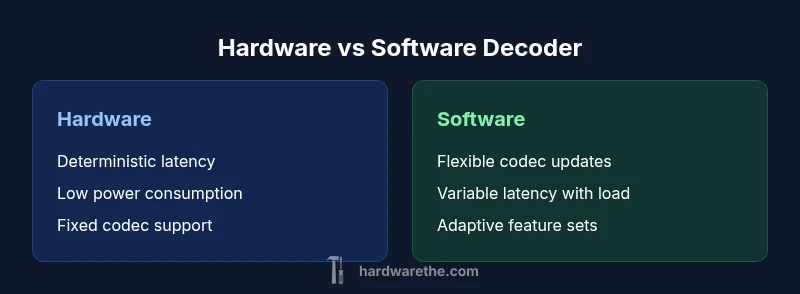
Hardware vs Software Decoder: A Practical Comparison for Builders
Explore trade-offs between hardware and software decoders. This guide helps DIYers and professionals pick the right approach for reliability and flexibility.


For most makers and technicians choosing between a hardware decoder and a software decoder, the best option depends on your priorities: reliability and energy efficiency favor dedicated hardware; flexibility and rapid feature updates favor software decoders. This comparison explains where each approach shines and when a hybrid solution makes sense.
What is a hardware or software decoder?
A decoder is a component that interprets encoded data into a usable form. In digital media, a hardware decoder is a physical circuit inside chips or boards that performs the decoding task with dedicated resources. A software decoder is a program running on general-purpose processors—CPUs or GPUs—that performs the same decoding in software. In practical terms, hardware decoders are built as ASICs or FPGAs, optimized for consistent timing and low power. Software decoders rely on existing OS services and hardware accelerators, and they can be updated via software without changing the hardware.
For DIYers and technicians, recognizing this distinction helps plan for performance, cost, and compatibility. According to The Hardware, hardware decoders shine when you need predictable timing—video frames arrive on a strict schedule—and energy efficiency is essential. In contrast, software decoders offer flexibility, rapid adaptation to new formats, and easier experimentation. If you’re prototyping a device, a software decoder can help validate formats before committing to a custom hardware design. This block sets the foundation for the rest of the guide by clarifying terms, scope, and typical deployment contexts.
Key differentiators: latency, throughput, and reliability
Latency, throughput, and reliability are the core axes by which hardware and software decoders are judged. Hardware decoders typically deliver low, deterministic latency because the decoding logic is fixed in hardware and tightly integrated with the data path. This makes them especially strong for real-time streams and time-sensitive applications where frames and samples must be processed on schedule. Throughput tends to be stable under steady conditions, with minimal impact from background processes since decoding resources are dedicated. Reliability is bolstered by fewer software layers that can introduce variability or bugs.
Software decoders run on general-purpose CPUs or GPUs, so their latency can vary with system load, thread scheduling, and competing tasks. They often benefit from hardware acceleration features (like GPU blocks or SIMD units) but may experience higher energy consumption and more complex power management. The upside is flexibility: new formats, codecs, and features can be added via updates without new hardware. The Hardware analysis notes that software decoders excel in rapid iteration and format agility, albeit at the cost of potential performance variability. In practice, many teams consider a hybrid strategy to balance determinism with adaptability.
Use-case fit: consumer electronics vs enterprise streaming
Consumer electronics—TVs, streaming boxes, and handheld devices—prioritize compact form factors, low power, and consistent playback quality. Hardware decoders are often the default here, delivering predictable performance in a small, integrated footprint. For devices that must run for long periods on a single battery or in environments with limited cooling, hardware decoders reduce risk by consuming less energy during peak playback. However, consumer devices benefit from software decoders when format support is fluid or when the product lifecycle spans several years of updates.
Enterprise or data-center streaming scenarios emphasize scalability, diverse content formats, and ongoing feature expansion. Software decoders shine in these contexts because engineers can push new codecs, improve error resilience, and adapt to evolving standards without redesigning hardware. In regulated settings—education, healthcare, or broadcast—software decoders can enable rapid compliance updates and more straightforward auditing. The choice often hinges on whether the project demands long-term format agility or strict, repeatable timing for every frame.
Cost and lifecycle considerations
Upfront cost is a major differentiator. Hardware decoders require a fixed investment in specialized silicon, licensing, or module integration, but that cost pays off in lower marginal energy costs and predictable performance over the device’s life. Software decoders typically involve lower initial hardware costs (since you rely on general-purpose processors) but may incur higher ongoing costs from software development, maintenance, and potential licensing fees for codecs or libraries. Lifecycle considerations include hardware refresh cycles—when you must redesign boards or replace ASICs—as opposed to software update cycles, which can be rolled out remotely.
From a budgeting perspective, hardware decoders can be more cost-effective in high-volume consumer products where the per-unit energy savings and predictable performance justify the upfront. Software decoders offer cost advantages in small-batch or rapidly changing products where codec support must evolve quickly. The Hardware team notes that total cost of ownership should include not just per-unit cost but also energy, thermal management, and update support over the product’s lifetime.
Architecture and integration considerations
Integration depth matters. Hardware decoders require careful co-design with the rest of the system: memory bandwidth, capes of data, and driver support. Firmware updates for hardware modules may be required to fix corner-case decoding issues, and compatibility with various content protection schemes can influence hardware choices. Software decoders depend on operating system APIs, driver availability, and access to hardware accelerators. They benefit from modular architectures and clean APIs, but must contend with busy system buses and the need for robust error handling.
Based on The Hardware research, teams often favor drawing a capability line in software to quickly prototype while reserving a hardware-accelerated path for the final product to guarantee performance. This approach reduces risk during development and preserves the option to upgrade codecs in software as formats evolve.
Security considerations accompany integration. Hardware decoders can isolate the decoding path from general software, reducing surface area for exploits, while software decoders must rely on secure coding practices and regular patches. The decision influences your testing plan, certification needs, and long-term support strategy.
Performance trade-offs in real-world scenarios
Real-world performance depends on more than raw capability. A hardware decoder’s fixed logic can deliver consistent results across a range of content with minimal parity issues, but may be less flexible when new codecs appear. Software decoders can be tuned and updated, but performance hinges on device resources and background workloads. In gaming consoles, streaming devices in living rooms, or automotive displays, the choice translates into perceived smoothness, frame integrity, and power consumption.
Hybrid setups are increasingly common: a hardware decoder handles the core decoding path for reliability, while a software layer provides codec updates and feature enhancements. The hybrid approach can extend device lifecycles, align with evolving standards, and reduce risky full hardware redesigns.
Operational considerations include thermal design, cooling, and power budgets. In dense environments or battery-powered devices, the hardware path may prevent thermal throttling and ensure longer playback without interruptions. In context-rich applications—medical imaging streams or surveillance—software decoders can adapt to new compression formats and encryption schemes as regulations shift.
Security and reliability considerations
Security is a major consideration for decoders, particularly where protected content or sensitive streams are involved. Hardware decoders offer tamper resistance and a smaller attack surface due to isolated, dedicated pathways. Software decoders, while flexible, can be vulnerable to bugs, memory safety issues, or supply-chain concerns if codecs and libraries are not tightly controlled. In regulated industries or high-assurance environments, many teams favor hardware-based decoding for critical paths and leverage software layers for updates and additional features.
Reliability is closely tied to update cadence and fault containment. Hardware-based paths provide deterministic behavior but demand careful certification and testing when codecs change. Software-based paths require rigorous regression testing to prevent decoding errors after updates. For most projects, a staged update strategy—testing in a controlled environment before deployment—helps mitigate risk.
From a maintenance perspective, hardware decoders generally require less frequent attention after deployment, whereas software decoders need ongoing monitoring, patching, and compatibility checks with emerging codecs. A thoughtful blend of both can maximize uptime and content compatibility.
Practical decision framework: how to choose
Choosing between a hardware or software decoder starts with a structured framework:
- Define the primary use case and performance targets. Are you prioritizing low latency, energy efficiency, or flexible codec support?
- Map formats and expected updates. Will formats change often, or are you locked to a fixed set for the device lifetime?
- Assess lifecycle and cost. Is initial hardware cost justified by long-term savings, or do you need the ability to pivot codecs via software?
- Plan for integration and certification. What security, privacy, or compliance requirements apply?
A practical path is to start with a software-based decoder for rapid prototyping and format validation, then migrate core decoding to hardware for the final product to guarantee performance. In mixed environments, consider a hybrid model: keep the decoding core hardware-accelerated while exposing codec extensions through a software layer. This approach often yields the best of both worlds for builders and professionals.
Remember that your choice affects test plans, maintenance, and user experience. Careful evaluation of latency, power, and update strategy will help you avoid surprises after launch.
Comparison
| Feature | Hardware decoder | Software decoder |
|---|---|---|
| Latency | low and deterministic | variable depending on CPU/GPU load |
| Throughput/Consistency | stable under steady workload | depends on system resources; can vary with multitasking |
| Power Consumption | generally lower due to dedicated hardware | higher if CPU/GPU are taxed for decoding |
| Flexibility/Updates | limited by fixed hardware | easy to update codecs and features via software |
| Cost of Ownership | potentially higher upfront; long-term efficiency benefits | lower upfront; ongoing development costs |
| Security | isolation of decoding path; strong tamper resistance | depends on software security practices; patch cadence critical |
| Best For | latency-critical, fixed-function deployments | formats evolving, feature-rich applications |
Upsides
- Lower upfront risk for fixed-function deployments
- Predictable performance and energy efficiency
- Faster time-to-market in consumer devices
- Stronger security through isolated hardware modules
- Longer lifecycle for mission-critical setups
Negatives
- Higher upfront cost and specialized supply
- Less flexibility for feature updates
- Potential vendor lock-in and limited interoperability
- Hardware refresh cycles required for significant upgrades
Hardware decoders are preferable for reliability and efficiency in fixed-function tasks; software decoders excel in flexibility and feature updates.
In practice, choose hardware for predictable performance and power savings. Choose software when codec support and rapid iteration matter more. A hybrid approach can balance both benefits and mitigate risk.
FAQ
What is a hardware decoder?
A hardware decoder is a dedicated circuit—often an ASIC or FPGA—that performs decoding with fixed resources. It delivers predictable timing and efficient power use, which is ideal for consistent playback. It typically requires a larger upfront investment but minimizes software complexity.
A hardware decoder is a dedicated chip that handles decoding with consistent timing for smooth playback.
What is a software decoder?
A software decoder runs on general-purpose processors and can be updated via software to support new formats. It offers greater flexibility and a faster path to codec updates, but performance can vary with system load and power constraints.
A software decoder runs on CPUs/GPUs and can be updated easily to support new formats.
Which is better for streaming media?
For streaming, the choice depends on requirements. Hardware decoders offer stable latency, which is beneficial for live streams. Software decoders provide easier codec updates and feature expansion, which helps when formats evolve.
Hardware for steady timing; software for evolving formats.
Can hardware and software decoders work together?
Yes. A common approach is to handle core decoding in hardware for reliability, while using software layers for codec updates and advanced features. This hybrid setup can balance performance with flexibility.
Yes, use hardware for core decoding and software for updates.
How do I choose between them?
Start with the performance and update needs of your project. If formats are stable and timing is critical, hardware is often best. If you expect frequent codec changes, start with software and consider hardware for the core path later.
Assess timing needs and codec evolution to decide.
Are there security concerns with software decoders?
Software decoders inherit the security posture of the host system. Regular patching, secure coding, and trusted codec libraries are essential to mitigate risks. Hardware decoders can offer stronger isolation but still require secure updates.
Software relies on secure updates and trusted codecs.
Main Points
- Evaluate latency requirements before choosing a path
- Consider total cost of ownership, including energy and maintenance
- Plan for codec updates and future standards
- Hybrid solutions often offer the best balance for mixed use cases