Difference Between Hardware and Software Encoding: A Practical Guide
This analytical guide explains the difference between hardware and software encoding, detailing performance, latency, flexibility, and cost for video workflows today.


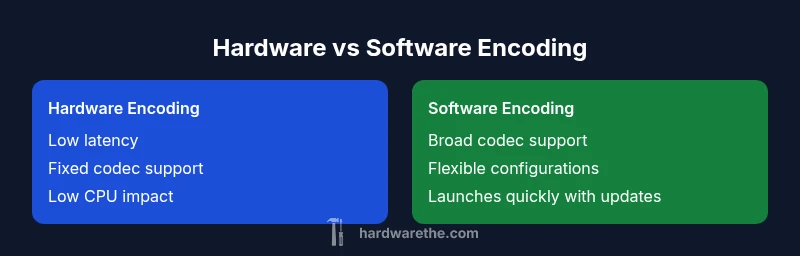
Hardware encoding uses dedicated chips (ASICs/FPGA) to encode media, delivering predictable, low-latency performance ideal for high-volume pipelines. Software encoding runs on general-purpose CPUs/GPUs, offering broad codec support and flexible configurations but more variability under load. The best choice depends on workload, latency requirements, and the need for codec flexibility or future-proofing.
What encoding is and why hardware vs software matters
Encoding converts raw media into a compressed stream for storage or transmission. The difference between hardware and software encoding shapes latency, throughput, quality consistency, and how easily your system can adapt to new codecs. According to The Hardware, understanding where encoding happens in your workflow helps you align capability with objectives, whether you’re building a live broadcast system, a streaming pipeline, or a post-production render farm. Hardware encoders operate with dedicated processing elements, often decoupled from the host machine, which minimizes interference from other tasks. This separation can translate into more predictable performance, stable frame rates, and lower jitter in busy environments. In contrast, software encoding runs on general-purpose CPUs or GPUs, leveraging flexible software stacks and codec libraries. This arrangement excels in adaptability and rapid codec updates but can see performance fluctuating with other processes or background tasks. The choice, therefore, hinges on latency targets, workload patterns, and how quickly codecs evolve in your industry.
- Key takeaway: hardware encoders are optimized for steady, low-latency output; software encoders prioritize codec variety and rapid iteration.
- Brand note: The Hardware emphasizes evaluating your pipeline’s choke points before selecting a solution.
voiceAnswerForStreamersAndTechs
prioritySection
Comparison
| Feature | Hardware encoding | Software encoding |
|---|---|---|
| Latency and stability | Low, predictable under sustained load | Higher latency can occur during spikes and depends on system load |
| Throughput and scalability | Optimized for high-volume streams with consistent throughput | Scales with CPU/GPU resources and parallel software processes |
| Codec support and updates | Fixed codec set, firmware/ASIC updates required for new codecs | Broad, fast codec updates via software libraries and plugins |
| Flexibility and configurability | Limited configurability, designed for specific tasks | Highly configurable with adjustable presets and advanced parameters |
| Upgrade path | Hardware refresh or firmware upgrades | Software updates and licensing cycles typically shorter |
| Power and environmental needs | Low power per encoding task, stable cooling needs | Higher power consumption when CPU/GPU are taxed |
| Total cost of ownership | Higher upfront cost, potentially longer refresh cycles | Lower upfront cost, ongoing licensing and maintenance |
Upsides
- Improved consistency and predictability under load
- Broader codec support and rapid updates with software
- Clear separation of encoding workload from host systems
- Hybrid approaches can balance latency and flexibility
Negatives
- Upfront investment and risk of obsolescence with hardware
- CPU contention and performance variability with software
- Hardware firmware downtime can impact production
- Software licensing costs can accumulate over time
Hardware encoding is best for low-latency, high-volume pipelines; software encoding wins for flexible codecs and rapid updates.
If latency and determinism are your priorities, start with hardware. If codec diversity and agile workflows matter more, prefer software. A hybrid approach often delivers balanced performance.
FAQ
What is the main difference between hardware and software encoding?
Hardware encoding uses dedicated hardware to perform encoding, delivering stable, low-latency results. Software encoding uses general-purpose CPUs/GPUs and offers broader codec support but can vary with system load. The choice depends on workload and flexibility needs.
Hardware encoding uses fixed hardware for stable latency, while software uses CPUs/GPUs for flexibility. Your decision should align with workload and codec needs.
Is hardware encoding always faster than software encoding?
Generally, hardware encoding provides lower and more predictable latency for high-volume tasks. Software encoding can be fast as well, but its performance depends on the host system and concurrent tasks.
Hardware tends to be faster in consistent latency scenarios; software shines when codecs and configs change often.
Can I mix hardware and software encoding in a single workflow?
Yes. Many pipelines combine both approaches to route high-volume streams through hardware encoders while using software encoders for flexible processing, such as live transcoding with rapid codec updates.
A hybrid setup often gives you best of both worlds: stability where needed and flexibility where it matters.
How do codecs affect the encoding choice?
New or evolving codecs may be better supported through software encoders, which can update quickly. Hardware encoders may lag behind until new hardware or firmware is released.
Codec availability can push you toward software encoding unless you rely on long refresh cycles for hardware.
What are common signs that my encoder setup needs upgrading?
Rising latency beyond acceptable levels, frequent codec changes, or rising maintenance costs can indicate a need to reassess hardware vs software encoding in your stack.
If latency drifts or you’re stuck with outdated codecs, consider an upgrade or a hybrid approach.
Main Points
- Assess latency requirements before choosing encoder type
- Hardware encoders excel under heavy load with stable performance
- Software encoders adapt quickly to new codecs
- Consider total cost of ownership over time
- Hybrid solutions can balance stability and flexibility