Hardware vs Software Encoding: Which Is Better? A Practical Guide
A practical, analytical comparison of hardware vs software encoding, covering latency, flexibility, cost, and real-world use cases to help you pick the right approach for media, surveillance, and data pipelines.


Is hardware or software encoding better? In most professional contexts, hardware encoding provides lower latency and energy-efficient consistency for fixed pipelines, while software encoding offers flexibility, rapid codec updates, and broader compatibility. According to The Hardware, the best choice depends on workload profile, latency targets, and system constraints. Many teams adopt a hybrid approach to balance performance and adaptability.
The Core Question: Is Hardware Encoding Better or Software Encoding?
If you're asking is hardware or software encoding better, the short answer depends on your workload, latency targets, and deployment constraints. According to The Hardware, hardware-accelerated encoders excel in fixed pipelines where the input stream is predictable and throughput must be guaranteed. In contrast, software-based encoders shine when codecs evolve quickly, feature sets expand, or you must harmonize encoding with broader data-processing tasks. The question is not a simple yes or no; it’s a spectrum of trade-offs framed by performance, cost, and ecosystem compatibility. The Hardware team’s analysis shows that most organizations increasingly adopt a hybrid stance, using hardware blocks for the baseline encoding path while keeping software paths for experimentation, fast updates, and specialized codecs. Throughout this guide, we’ll explore is hardware or software encoding better in different contexts, and provide a practical framework to decide based on your specific requirements. By the end, you’ll have a clear decision pathway rather than a vague impression.
Understanding Hardware Encoding: How It Works and When It Shines
Hardware encoding relies on dedicated blocks within a processor, ASICs, FPGA accelerators, or system-on-module encoders designed to perform a limited set of encoding tasks with maximum efficiency. The primary benefits are low, predictable latency and deterministic throughput, which are critical in broadcast pipelines, surveillance feeds, and live streaming where timing is everything. Because the encoder is purpose-built, it typically consumes less power for the same bitrate targets and generates less heat under sustained operation. This makes hardware encoding a natural fit for fixed configurations where input formats, resolutions, and code rates remain stable for long periods. However, the same specialization means codec support and feature updates can lag behind software options, requiring planned refresh cycles to maintain parity with evolving standards. The core question remains: is hardware encoding better for your scenario? If your workload is stable and latency budgets are tight, hardware often wins; if you must evolve codecs frequently, software encoding can provide the edge.
Understanding Software Encoding: Flexibility and Control
Software encoding leverages general-purpose CPUs, GPUs, or accelerators to perform encoding in software or firmware stacks. The strength of software encoding is versatility: it accommodates a wide range of codecs, profiles, and optimization strategies, and can be updated quickly when standards shift or new features are released. This flexibility is especially valuable in media applications where codecs like H.265/HEVC, AV1, and emerging codecs require rapid adaptation. Software encoders also integrate more easily with complex pipelines that involve pre-processing, analytics, and adaptive streaming logic. The trade-off is higher variability in latency and CPU load, which can complicate real-time use cases unless the environment is carefully managed. In practice, teams weighing is hardware or software encoding better must weigh the cost of flexibility against the need for predictability and energy efficiency.
Key Differences at a Glance: Latency, Throughput, and Quality
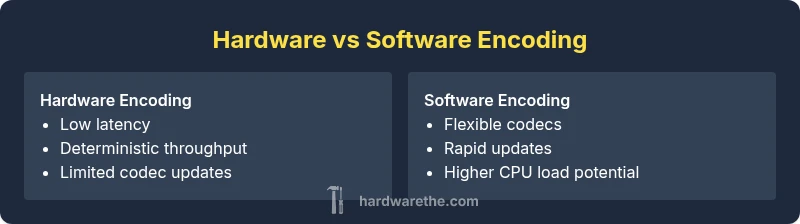
When comparing is hardware encoding better or software encoding, the most salient axes are latency, throughput stability, and codec flexibility. Hardware encoders tend to deliver lower, more predictable latency and stable throughput for fixed streams, with lower system load on the host CPU. Software encoders offer higher adaptability, better support for rapid codec updates, and easier experimentation with new features, at the risk of sways in CPU usage and occasional latency jitter. Throughput quality also differs: hardware paths favor steady, repeatable performance, while software paths can adapt to bursty traffic and varying bitrates more nimbly. For many workloads, the best option is a hybrid approach that uses hardware for baseline encoding and software for on-the-fly adjustments, dynamic codec selection, and experimentation. The decision should be guided by workload mix, latency tolerance, and ecosystem constraints rather than a single metric.
Real-World Scenarios: Pro Media, Surveillance, and Data Centers
In professional media production, where raw footage must be converted into delivery-ready streams with strict deadlines, hardware encoding can minimize encoding bottlenecks and reduce power consumption in control rooms. In surveillance systems, deterministic latency matters for live monitoring and incident response, making hardware paths attractive for continuous operation. Data centers and CDNs often rely on software-encoded pipelines for their codec diversity and ability to adapt to new formats without replacing hardware. Embedded systems, on the other hand, may require a careful balance: hardware encoders can handle fixed-rate streams efficiently, while software encoders enable updates to support new codecs and streaming standards without modifying the hardware. When considering is hardware or software encoding better for your project, map your workloads to these scenarios and prioritize latency requirements, total cost of ownership, and future-proofing needs.
Benchmarks and Measurement: What the Numbers Tell Us (and What They Don’t)
Quantitative benchmarks help anchor the discussion around is hardware encoding better or software encoding, but numbers must be interpreted in context. Hardware encoders typically demonstrate lower latency under steady-state workloads and lower power draw for comparable bitrate paths, making them compelling in production environments with fixed pipelines. Software encoders can surpass hardware in peak throughput during bursts and in environments where codec licenses or feature updates are the primary constraints. It’s essential to measure encoder path performance with your actual data, input formats, and network conditions, rather than relying on generic labels. Remember that codec quality, rate control, and error resilience also influence perceived quality, so evaluations should consider perceptual quality metrics alongside raw throughput. The Hardware’s analysis emphasizes aligning measurement with real use cases: latency targets, variability budgets, and update cadence drive the optimal encoding path more than any single benchmark score.
Implementation Considerations: Integration, Compatibility, and Maintenance
Choosing between is hardware or software encoding better also hinges on how well the solution fits your integration environment. Hardware encoders demand compatibility with your existing capture cards, transport streams, and monitoring systems, and may require vendor-specific software for control and status reporting. Software encoders benefit from broad SDKs, APIs, and community support, but require careful resource planning to prevent CPU contention and thermal throttling in high-load deployments. Maintenance cycles differ: firmware updates for hardware encoders are typically periodic, while software encoders receive frequent updates through package repositories or cloud pipelines. A mixed environment should include clear governance for firmware levels, codec licenses, and update strategies, plus a rollback plan in case a new codec introduces regression in quality or stability. In short, plan integration points, monitor compatibility with your pipeline stages, and design for manageable upgrade paths when deciding is hardware or software encoding better for your architecture.
Cost and Total Cost of Ownership: Upfront vs Long-Term Value
Total cost of ownership often drives the decision about is hardware encoding better for your budget. Hardware encoders require upfront capital expenditure and may incur shelf-life depreciation tied to codec support windows and product refresh cycles. The immediate savings come from lower ongoing power usage and reduced CPU load, which can translate into lower data-center costs over time for fixed workloads. Software encoders typically have a lower upfront cost and scale with the host hardware you already own; however, they can incur hidden costs in licensing, higher energy consumption, and potential performance tuning to achieve the same latency targets. A conservative TCO model should consider not only the price tag but also the cost of updates, maintenance, and the risk of obsolescence if codec support declines. In many organizations, a hybrid solution minimizes upfront capex while preserving the ability to scale or adapt as standards evolve. The right balance depends on workload stability, upgrade cadence, and the expected timeline for codec diversification.
How to Decide: A Practical Checklist for Choosing Encoding Method
To answer is hardware or software encoding better for your case, use a practical checklist:
- Define latency targets and jitter budgets for each pipeline stage.
- Inventory codecs and update frequency—how often will you need new codecs or feature enhancements?
- Assess workload stability—are inputs predictable or highly variable?
- Evaluate total cost of ownership, including energy, licensing, and maintenance.
- Consider integration complexity and the ability to upgrade without downtime.
- Plan for future-proofing: can you add new hardware or software paths without a full re-architecture?
- Pilot with a hybrid setup to quantify trade-offs in your environment.
If you want a concise recommendation: hardware encoding is best where latency and predictability matter most; software encoding is best where flexibility and rapid updates are critical. In many cases, a blended approach offers the strongest value, allowing you to reserve hardware paths for core streams while routing flexibility-driven tasks to software encoders. This aligns with the practical guidance from The Hardware and mirrors common industry practice when tackling is hardware or software encoding better in real-world deployments.
mainTopicQuery
hardware encoding
Comparison
| Feature | Hardware Encoding | Software Encoding |
|---|---|---|
| Latency | Low, predictable | Higher variability, potential jitter |
| Throughput/Load Handling | Stable under fixed streams | Adaptive with bursts; higher peak potential |
| Codec Support | Limited to hardware codecs | Broad, rapidly updating codecs |
| Flexibility | Low to moderate | High; easy to experiment |
| Power & Cooling | Low power draw under steady load | Higher power depending on host load |
| Cost | Higher upfront capex | Lower initial cost, ongoing licensing considerations |
| Maintenance & Upgrades | Firmware updates; longer refresh cycles | Frequent updates; software ecosystem changes |
| Integration | Tighter integration with fixed pipelines | Easier integration with software stacks and APIs |
Upsides
- Lower latency for fixed pipelines
- Deterministic performance under steady workloads
- Energy efficiency in continuous operation
- Predictable maintenance with dedicated hardware
- Clear upgrade paths for specialized codecs (with vendor support)
Negatives
- Higher upfront cost for hardware solutions
- Limited codec flexibility and slower updates
- Potential bottlenecks if workloads evolve beyond hardware design
- Refresh cycles require hardware swaps or reconfigurations
Hybrid architectures offer the best balance for most teams
Hardware encoding excels in latency-sensitive, fixed pipelines, while software encoding offers codec flexibility and rapid updates. The Hardware recommends a hybrid approach when workloads demand both stability and adaptability, allowing you to optimize for cost, performance, and future-proofing.
FAQ
What is hardware encoding?
Hardware encoding uses dedicated hardware blocks (ASICs/FPGA/SoC) to perform encoding tasks. It delivers low latency and consistent throughput but may offer less codec flexibility and longer upgrade cycles. This makes it ideal for fixed pipelines with predictable input streams.
Hardware encoding uses dedicated chips to encode, giving fast, predictable results but less codec flexibility.
What is software encoding?
Software encoding relies on general-purpose processors or software stacks to perform encoding. It offers broad codec support and rapid updates, making it ideal for evolving pipelines, but it can introduce latency variability and higher host CPU usage.
Software encoding uses the CPU to encode, offering flexibility but potentially more latency variation.
Is hardware encoding always better for production?
Not necessarily. Hardware encoding is excellent for fixed, latency-critical pipelines, but if your workloads require frequent codec changes or rapid feature updates, software encoding may be preferable. A hybrid setup often provides the best balance.
Hardware is great for fixed workloads; software wins for frequent updates. Hybrid often works best.
Can I run both encoding paths in one system?
Yes. Many systems implement a hybrid pipeline where hardware handles baseline encoding while software paths handle codec updates, format conversions, and adaptive streaming logic. This approach can maximize performance while preserving flexibility.
Yes, you can run both paths together for balance.
What factors should influence the encoding choice?
Key factors include latency requirements, codec update cadence, input format stability, total cost of ownership, and integration with existing pipelines. Align those factors with your long-term roadmap to decide the best approach.
Focus on latency needs, update cadence, and cost to guide your choice.
How do I evaluate encoder performance in my environment?
Run a controlled pilot that mirrors your production workload. Measure latency, jitter, CPU/dGPU load, power use, and codec quality. Compare hardware and software paths under realistic traffic to inform the final decision.
Test with real workloads and compare latency, load, and quality.
Main Points
- Prioritize latency targets when choosing hardware encoding
- Prefer software encoding for codec flexibility and rapid updates
- Aim for a hybrid architecture to balance stability and adaptability
- Evaluate TCO, considering licensing, power, and maintenance
- Pilot with your real workload to confirm performance expectations