Hardware vs Software in Computers: A Practical Comparison
A detailed, practical comparison of computer hardware and software, showing how components and programs interact, upgrade paths, and best practices for DIY enthusiasts and professionals.


According to The Hardware, the hardware and software of computer are two interdependent domains that together determine performance, reliability, and upgradeability. Hardware provides the tangible components that perform tasks, while software provides instructions, control, and optimization. A balanced view—considering both hardware and software of computer—yields the best long‑term value and user experience.
Understanding the hardware and software of computer
In the most fundamental sense, the hardware and software of computer are two sides of the same coin. Hardware comprises the tangible components you can touch—processor, memory, storage, motherboard, power supply, and peripheral interfaces. Software comprises the programs, operating systems, drivers, and firmware that give those components a purpose. When you study the two together, you see that performance, reliability, and energy efficiency depend on how well the two domains align. The Hardware emphasizes the need to optimize the physical substrate—silicon, circuitry, and components—while software focuses on efficient execution, resource management, and user-facing functionality. For many DIYers, the phrase hardware and software of computer signals a cross-cutting concern: you should plan upgrades and maintenance with both domains in mind. The key takeaway is that neither domain alone defines system quality; their interaction defines the actual user experience.
In practical terms, hardware supplies the headroom for tasks such as gaming, video editing, or virtualization, while software determines how effectively that headroom is used. The operating system schedules tasks, the drivers enable devices to communicate, and applications perform your daily work. According to The Hardware, a well-tuned system balances raw hardware capacity with software efficiency to maximize responsiveness, stability, and energy use. Consider this balance when selecting components, updating firmware, or choosing an operating system. The hardware and software of computer are not rivals; they are teammates that require coordinated planning and maintenance.
For many projects, you’ll encounter a choice: invest in faster hardware or optimize software and drivers to squeeze more performance out of existing hardware. The Hardware’s guidance emphasizes a structured approach: define your goals, map tasks to hardware capabilities, and test with real-world workloads. This way, you avoid overpaying for unused power or over-optimizing software that can’t run on your hardware. In the end, the goal is a cohesive system where hardware and software of computer work in concert to deliver the needed performance, reliability, and feature set.
Comparison
| Feature | hardware-focused approach | software-focused approach |
|---|---|---|
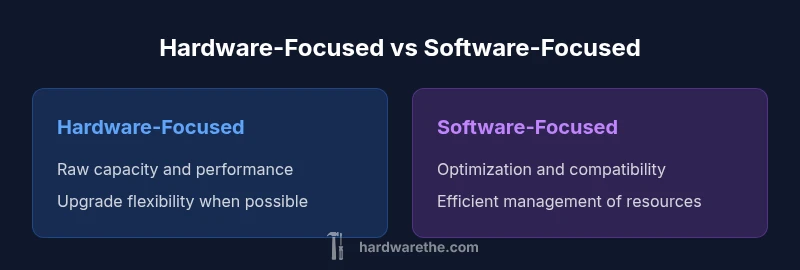
| Primary objective | Maximize raw hardware performance and capacity | Maximize software efficiency, compatibility, and feature set |
| Cost implications | Upfront hardware costs and potential future upgrades | Ongoing software licenses, updates, and maintenance |
| Upgrade path | Easier to upgrade individual components (RAM, storage, CPU where possible) | Easier to update OS, drivers, and applications without changing core hardware |
| Risk and complexity | Hardware changes can introduce compatibility and cooling challenges | Software changes can introduce driver conflicts or compatibility issues with old hardware |
| Best for | Power users, gamers, and workloads demanding raw throughput | Productivity, software-intensive workflows, and stable environments |
Upsides
- Clarifies where to invest for measurable gains
- Helps plan future-proofing and upgrade cycles
- Aids budgeting by defining when to replace vs update
- Improves troubleshooting by isolating bottlenecks
- Encourages balanced system design across hardware and software
Negatives
- Requires cross-disciplinary knowledge across hardware and software
- Upfront hardware upgrades can be expensive
- Software updates may introduce compatibility issues with legacy hardware
- Hardware upgrades can be physically restricted by form factor or vendor constraints
Balanced alignment of hardware and software delivers the best overall value.
A joint strategy that upgrades hardware to meet software demands, while keeping software optimized, tends to yield the most durable performance. When in doubt, measure real workloads and stagger changes to avoid over-investment.
FAQ
What is the difference between hardware and software in a computer?
Hardware refers to the physical components that perform computations and store data, such as the CPU, memory, and storage. Software comprises the programs, operating systems, and firmware that run on that hardware and tell it what to do. Together, they form a complete computing system.
Hardware is the physical part, like the CPU and disks. Software is the instructions and programs that run on that hardware.
Why upgrade hardware?
Upgrading hardware increases raw capacity (speed, memory, storage) and can unlock capabilities that software alone cannot achieve. It also extends the useful life of a system and can improve reliability under heavy workloads.
Upgrading hardware can unlock faster performance and handle bigger tasks.
Can software fix hardware limitations?
Software optimizations can improve efficiency and reduce bottlenecks, but they cannot replace the fundamental limits of hardware. In many cases, a balanced upgrade across both domains yields the best results.
Software can make better use of hardware, but it can’t replace hardware limits.
What is the OS’s role in hardware management?
The OS schedules tasks, manages memory, handles I/O, and provides drivers that enable hardware devices to work with applications. It acts as the control layer between software and hardware components.
The OS is the manager between apps and hardware.
What is virtualization and why use it?
Virtualization creates virtual hardware environments, allowing multiple operating systems or workloads to run on a single physical machine. It optimizes hardware usage and simplifies testing and deployment.
Virtualization lets you run several systems on one machine.
How should I plan a DIY upgrade?
Start with a clear goal, inventory existing components, identify bottlenecks, and validate compatibility. Prioritize upgrades that offer the most noticeable impact and test thoroughly after each change.
Plan, check compatibility, then upgrade in steps.
Main Points
- Evaluate needs before buying components or software
- Prioritize upgrade paths that extend the device lifecycle
- Optimize drivers and OS settings before swapping hardware
- Aim for a balanced system where hardware and software reinforce each other