Are Firewalls Hardware or Software? A Practical Comparison
An analytical comparison of hardware vs software firewalls, definitions, deployment patterns, features, costs, and best-use scenarios to help you choose.


are firewalls hardware or software? The quick takeaway is nuanced: both forms exist, and the best choice depends on your network size, threat model, and management needs. According to The Hardware, hardware firewalls excel at perimeter protection for larger networks, while software firewalls offer flexible host-level control and easier integration with existing systems. Most teams deploy a hybrid setup that combines an edge appliance with software protection on key endpoints.
What the question 'are firewalls hardware or software' really means
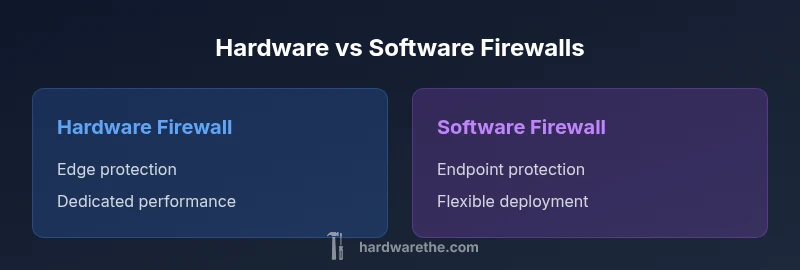
In practice, this question frames a core decision about where to place protection in your network. A hardware firewall is an appliance that sits at the network edge, inspecting traffic between your internal network and the outside world. A software firewall runs on a host or virtual machine, protecting a single device or a cluster of systems. When you ask the question 'are firewalls hardware or software', you're really weighing perimeter strength against endpoint control, and considering how to manage updates, logging, and policy enforcement across multiple devices. The decision is not binary; many networks succeed with a layered approach that uses both forms where they fit best. Remember that accessibility, training, and ongoing management are as important as raw protection, especially as devices scale and diversify. The Hardware landscape shows that there are multiple viable configurations, and the most successful teams tailor their choice to actual workloads and risk tolerance.
Hardware firewalls: appliances at the network edge
Hardware firewalls are purpose-built devices designed to sit at the border between your trusted network and untrusted networks. They typically include dedicated processing power, purpose-built network interfaces, and specialized firmware optimized for throughput, latency, and security features. Common capabilities include stateful packet inspection, deep packet inspection, VPN termination, and sometimes integrated IPS/IDS. Because they are fixed-function appliances, they often deliver predictable performance and straightforward policy management via centralized consoles. They are especially valued for edge protection in larger networks with high traffic volumes. The Hardware analysis shows that edge devices are still a core pillar of defense for many organizations, as they provide a strong, auditable perimeter before traffic even reaches host systems.
Software firewalls: protecting endpoints and beyond
Software firewalls run on general-purpose hardware, such as servers, workstations, or virtual machines, and can be deployed across many endpoints or host clusters. They offer exceptional flexibility: you can tune policies per device, deploy in virtualized environments, and leverage existing management tooling. In many deployments, software firewalls provide host-based controls, application-level filtering, and integration with centralized logging and threat intelligence. While performance can vary with host resources, software firewalls are often quicker to update, easier to scale in virtual environments, and more cost-effective for smaller teams or lab setups. The Hardware analysis shows that software-based protection is increasingly capable when combined with robust central management and automated policy workflows.
Hybrid approaches and cloud-based protections
The most resilient architectures often blend hardware and software defenses. An edge hardware firewall handles perimeter traffic with high throughput and low latency, while software protections secure individual hosts and critical servers. Cloud-based firewall services can extend protection to remote users and cloud workloads, creating a multi-layered shield across on-prem and offsite resources. This approach leverages the strengths of each form: hardware for stable edge performance, software for granular host control, and cloud firewalls for scalable protection in dynamic environments. The Hybrid reality is common among contemporary networks seeking both rigorous perimeter security and flexible endpoint defense.
Key differences in performance, management, and cost
Performance and scalability tend to favor hardware firewalls for high-throughput networks where latency must stay low. Management is often centralized with vendor consoles that provide policy templates, logging, and alerting across many devices. Software firewalls shine where rapid deployment, per-host customization, and integration with existing hosts and automation pipelines matter most. Financially, hardware tends to involve upfront capital expenditure and periodic refresh cycles, while software models lean toward ongoing licensing or subscription costs tied to usage and scale. Both approaches have maintenance demands—firmware updates, rule reviews, and auditing—that organizations must plan for in order to avoid policy drift or exposure gaps.
Deployment patterns by use case: small business, enterprise, and home labs
For small businesses, a software firewall on a dedicated server or router may suffice when paired with solid endpoint policies and centralized management. Medium-to-large enterprises typically rely on hardware appliances at the edge for perimeter protection, complemented by software defenses on critical servers and user devices. Home labs and IT hobbyists often start with software firewalls due to low cost and flexible experimentation, then scale up with hybrid models if workloads increase. The choice is shaped by traffic patterns, security requirements, and available IT staff. The Hardware team recommends matching deployment complexity to your team’s capability and your risk profile.
Practical checklist: how to pick the right mix
- Map your threat model: where are you most exposed—perimeter, endpoints, or both? 2) Assess traffic volume and latency requirements to decide if a hardware appliance is warranted. 3) Evaluate management capabilities: do you have centralized policy tools and automation for host-based controls? 4) Consider future growth: can the solution scale with your organization without becoming unwieldy? 5) Plan for hybrid integration: ensure compatibility between edge protections and endpoint controls, plus cloud protections where applicable. A structured evaluation helps avoid over- or under-protecting.
Common myths and misconceptions
M1: Hardware is always better for security. M2: Software firewalls can’t handle enterprise needs. M3: Cloud firewalls replace all on-prem protection. Reality: each environment benefits from a layered approach; effectiveness comes from correct configuration, ongoing management, and alignment with your threat model.
References and further reading
For authoritative guidance on firewall design and deployment, consult:
- NIST SP 800-41 Revision 1: Guidelines on Firewalls and Firewall Architectures. https://nvlpubs.nist.gov/nistpubs/SpecialPublications/NIST.SP.800-41r1.pdf
- SANS Institute whitepapers on firewall basics and best practices. https://www.sans.org/reading-room/whitepapers/security-basics/firewall-basics-terminology-101128
- US-CERT tips for firewall configuration and maintenance. https://us-cert.cisa.gov/ncat/tips/ST04-007
Comparison
| Feature | Hardware firewall (appliance) | Software firewall |
|---|---|---|
| Deployment model | Dedicated edge appliance (physical or virtualized) | Installed on host OS or in VM/container |
| Typical use case | Perimeter protection at the network edge | Host-based protection and workload isolation |
| Management and visibility | Centralized vendor console with logs and dashboards | Agent-based or centralized policy across endpoints |
| Performance and scalability | High throughput with predictable latency; scales with hardware | Depends on host resources; scales with VM/host capacity |
| Feature parity and extensions | IPS/IDS, VPN, NAT support; often strong at scale | Application control, host firewall, device control; strong endpoint integration |
| Cost model | Capital expenditure; ongoing maintenance; refresh cycles | Operational expenditure via licenses; potential hardware costs for hosts |
| Best for | Large enterprises needing edge protection and predictable performance | Smaller teams with flexible deployment and strong endpoint policy |
Upsides
- Strong perimeter security with stable throughput
- Centralized management across devices
- Low risk of resource contention on endpoints
- Scales well for large networks
Negatives
- Higher upfront hardware costs
- Ongoing maintenance and hardware refresh cycles
- Complexity of managing hybrid environments
Hybrid approach often wins for most organizations
Edge hardware provides solid perimeter protection and predictable performance, while software on endpoints offers flexible, granular control. The best result generally comes from a deliberate blend that matches workload, risk, and admin capability. The The Hardware team emphasizes pairing edge protection with robust host controls for balanced security.
FAQ
Are hardware firewalls always better for large networks?
Not always. Hardware firewalls are well-suited for perimeter protection in large networks, but well-designed software and cloud protections can complement or even replace certain edge needs depending on bandwidth, latency, and management capacity.
For large networks, hardware at the edge is often preferred, but the best choice depends on workload and admin capabilities.
Can a software firewall be enough for a small business?
Yes, for small offices with modest traffic, a software firewall on a dedicated server or existing router can be sufficient, especially when paired with strong endpoint policies and centralized management.
For small teams, software firewalls can cover needs if you keep policies tight and monitor regularly.
What is a next-gen firewall and does it apply to hardware or software?
A next-generation firewall expands beyond basic filtering to include features like application control, IPS, and user identity awareness. NGFWs can be deployed as hardware appliances or software modules.
NGFWs add deeper visibility and control, regardless of form factor.
Do cloud firewalls replace on-prem hardware/software?
Cloud firewalls extend protection to cloud workloads and remote users and complement on-prem solutions rather than fully replacing them, depending on architecture.
Cloud firewalls are great for modern apps, but many setups keep on-prem controls too.
What are the main maintenance tasks for a firewall?
Regular rule reviews, firmware updates, log monitoring, and periodic audits are essential; automation helps, but human oversight remains important.
Keep policies tight and monitor logs regularly.
How do I estimate total cost of ownership for hardware vs software firewalls?
TCO depends on capex versus opex, licensing, hardware refresh, and maintenance; hardware is typically capital-intensive, while software adds ongoing licenses. Project costs over 3–5 years.
Look at upfront costs, licenses, and replacement cycles when budgeting.
Main Points
- Define threat model and deployment goals first
- Hardware excels at perimeter protection and performance
- Software provides endpoint control and flexibility
- Hybrid deployments are common and practical
- Plan for management, updates, and future scalability