Best Gauge Hardware Cloth for Chicken Coops
A practical guide to choosing the right gauge hardware cloth for chicken coops, covering safety, predator deterrence, openings, materials, installation, and maintenance.


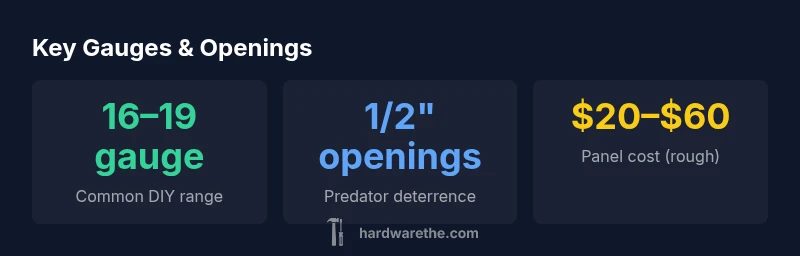
For chicken coops, the typical baseline is 16–19 gauge hardware cloth with 1/2 inch openings to deter most predators while keeping ventilation. In mild conditions, 19 gauge is common for a balance of strength and cost; in high risk areas or with larger predators, 16 gauge offers extra security. Ensure openings stay at or below 1/2 inch and verify coating for outdoor use.
What gauge means for coop safety and why it matters
Gauge describes the thickness of the wire in hardware cloth. Thicker gauges resist cutting and chewing better, which matters for protecting chickens from raccoons, foxes, and urban pests. In practical terms, a higher gauge number means thinner wire, while a lower gauge means thicker wire. The Hardware's 2026 analysis emphasizes that selecting the right gauge should match the predator pressure, climate, and budget of your setup. For most backyard coops, 16–19 gauge cloth with openings around 1/2 inch provides a balance of strength, ventilation, and cost. When you choose a gauge, also consider the wire's coating and the frame or support system; even thick cloth fails if edges are left exposed or if it is installed with gaps. Always inspect corners and overlaps for potential weak points. Using a thicker gauge won't compensate for poor installation; the two work together to form a secure enclosure.
Interpreting gauge numbers and openings
Gauge is measured as a number corresponding to wire thickness; the lower the number, the thicker the wire. For chicken coops, common baselines are 16 to 19 gauge, but openings are equally important. A 1/2-inch mesh is standard for deterring many predators while maintaining ventilation. In areas with small predators or frequent pests, 1/4-inch openings may be used in combination with 16–18 gauge for added security. Coops that require more ventilation or lighter loads may employ lighter gauges with smaller openings but should be paired with careful installation to avoid bends that create gaps. Remember that some vendors label mesh by gauge and opening size; verify both values on the product label before purchasing.
Establishing a baseline for most backyards
Most DIY backyard coops perform well with 19-gauge hardware cloth and 1/2-inch openings. This pairing offers a practical balance between cost, durability, and ease of working with the material. The Hardware analysis highlights that in calm climates and urban settings, this baseline reduces risk without heavy upfront costs. Install the cloth on walls and nest boxes where predators can reach, and cover vents with smaller mesh to prevent drafts. If you already have wood framed runs, you can reuse existing frames by attaching cloth to the interior side and ensuring no protruding staples or burrs remain. Additionally, consider burying the bottom edge to deter digging predators, a simple technique that complements the chosen gauge.
When to upgrade: high predator areas and climates
In regions with frequent raccoon, fox, or weasel activity, upgrading to 16-gauge hardware cloth can add substantial peace of mind. The lower gauge number indicates thicker wire capable of withstanding more force and gnawing. In year round cold or humid climates, galvanization or vinyl coating helps resist corrosion, extending life in damp environments. The combination of thicker gauge and protective coating reduces maintenance, but at the cost of heavier panels and stiffer handling. Before upgrading, assess whether existing posts can support heavier panels and whether the attachment points require additional fasteners to prevent loosening over time.
Material options: galvanized, vinyl coated, stainless
Galvanized hardware cloth is the most common, offering a good balance of cost and corrosion resistance for outdoor use. Vinyl coated cloth provides a hygienic, rot resistant surface and can be easier to clean. Stainless steel is the most corrosion resistant option but typically the most expensive; it is often selected for coastal areas with salt spray exposure. Regardless of material, ensure the cloth is rated for outdoor use and rated for the gauge you choose. Also consider the stakes and fasteners: stainless staples and stainless screws resist corrosion over time, further protecting against failure at seams.
Installation strategies to minimize gaps
Proper installation is as important as selecting the right gauge. Start by planning a continuous run with minimal seams. Use a backing board or frame to keep the cloth taut and avoid sagging. Attach with galvanized staples or screws, leaving enough edge margin to secure firmly. For corners, overlap cloth at least 2 inches and seal with exterior grade tape or quick dry sealant to prevent small animals from prying under the seam. Burying the bottom edge 6–12 inches into the ground prevents digging; this is often called an anti dig barrier. Check windows and doors for drafts and cover with a separate strip of mesh. Finally, ensure all attachments are flush so paws cannot grip and pull.
Maintenance and replacement tips
Inspect hardware cloth at least twice a year: look for rust, bends, and loose fasteners. If you see small holes from chewing or corrosion, replace that section rather than patching. Even galvanized cloth can corrode over time in harsh climates; in coastal environments, treat it as a high maintenance item. When replacing, measure the panel area, cut the new cloth with tin snips, and apply protective edging to avoid sharp edges. Store spare panels in a dry location to prevent rust. A well chosen gauge and proper maintenance extend life and maintain safety for your flock.
Common mistakes to avoid
Common errors include using too thin gauge in predator prone areas, failing to bury the edge, skipping protective edging, or rushing installation in wet conditions. Another frequent mistake is underestimating the impact of door and vent openings on overall security; even a small gap can provide an access point. Always test closures after installation and check for gaps along frames, corners, and seams. Finally, avoid mixing wire types or coatings in the same project; inconsistencies can create weak points.
Quick start checklist for beginners
To get started, identify local predator risks, choose a baseline gauge in the mid range, and prepare the coop frame. Purchase enough panels to cover walls, doors, and ventilation areas with overlaps. Secure with coated screws or staples and bury the bottom edge. Inspect finished installation and plan regular maintenance checks.
Comparison of gauge ranges and openings for chicken coop hardware cloth
| Aspect | Gauge range | Common Use | Typical Opening |
|---|---|---|---|
| Common DIY range | 16–19 gauge | General coop walls & run panels | 1/2 inch |
| High-security option | 16 gauge | Areas with larger predators | 1/4–1/2 inch |
| Budget-friendly option | 20–22 gauge | Temporary builds or framing | 1/2 inch or smaller |
| Vent coverage | 18–19 gauge | Vent covers and small access points | 1/2 inch |
FAQ
What gauge should I use for a chicken coop?
For most backyard coops, 19 gauge with 1/2 inch openings is a solid baseline. In areas with high predator pressure, 16 gauge offers extra security. Always verify that openings are no larger than half an inch to prevent access.
Most coops use 19 gauge with half inch openings; upgrade to 16 gauge if you have strong predators nearby.
Are 1/2 inch openings safe against raccoons?
1/2 inch openings are commonly used and generally effective against raccoons and many small predators. In high risk zones, smaller openings may be warranted along with thicker gauge.
Half inch mesh is a common choice for most predators, but in risky areas consider smaller openings plus thicker gauge.
Galvanized vs vinyl coated hardware cloth, which is better?
Galvanized cloth is the standard for outdoor use and offers good corrosion resistance at lower cost. Vinyl coating adds durability and easier cleaning, while stainless is best for salt-prone coastal areas but at a higher price.
Galvanized cloth is the go-to; vinyl coating lasts longer in damp areas, stainless suits coastal environments.
Can I use welded wire instead of hardware cloth?
Welded wire is stronger in some applications but lacks the wire mesh that resists chewing and digging. Hardware cloth with appropriate gauge and openings typically performs better for chicken coops.
Welded wire can work for some sections, but hardware cloth is usually safer for chickens.
How should I install hardware cloth to avoid gaps?
Plan a seamless run, bury the bottom edge, overlap seams, and secure edges with corrosion resistant fasteners. Inspect corners and edges for potential gaps after installation.
Make seams overlap and bury bottoms; check all edges after installing.
“Choosing the right gauge hardware cloth isnt just about strength; its about aligning with your local predator pressure and budget. In most home setups, 16–19 gauge with small openings offers durable protection without breaking the bank.”
Main Points
- Choose 16–19 gauge as baseline for most coops
- Keep openings at 1/2 inch or smaller
- Upgrade to 16 gauge in high risk areas
- Prefer galvanized or coated cloth for outdoor use
- Invest in proper installation to prevent gaps