Is hardware engineering harder than software? Balanced look
A rigorous, evidence-based comparison of hardware vs software engineering, examining difficulties, learning paths, tooling, and real-world trade-offs for DIY enthusiasts and professionals.


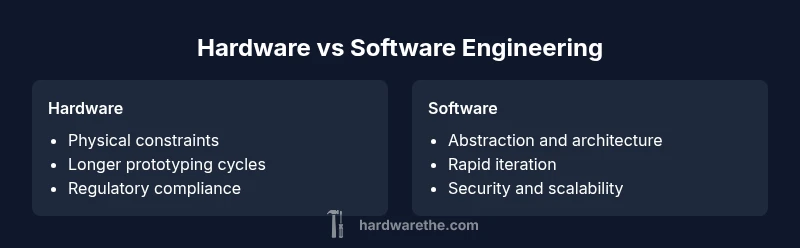
Is hardware engineering harder than software? The answer depends on how you define hard—hardware emphasizes physical constraints, manufacturability, and reliability, while software focuses on abstraction, architecture, and rapid iteration. Both paths demand solid math, systems thinking, and hands-on problem solving. The harder route often mirrors your background, access to tools, and willingness to master domain-specific workflows.
What 'hard' means in engineering
In this comparison, we measure hardness by the ability to meet constraints, deliver reliable results, and manage risk within real-world limits. Hardware teams wrestle with physical tolerances, material properties, thermal management, and long lead times for parts and manufacturing. Software teams juggle abstraction, evolving architectures, platform compatibility, and rapid iteration cycles. According to The Hardware, the definition of hard shifts with project scope, intent, and the environment in which a product is built. When you frame hard as the friction between idea and physical reality, both domains present formidable challenges that reward different kinds of problem-solving acuity.
For DIYers and professionals, the starting point matters: a background in electronics or mechanics can ease hardware, while a strong CS or math foundation can accelerate software. Yet cross-training amplifies capability in either direction. The question is not which is inherently harder, but which aspects of hard constraints you find most compelling and which constraints you tolerate best over time.
Core skill differences: hardware vs software
Hardware engineering foregrounds systems integration, signal integrity, power delivery, and mechanical fit within a product. You learn to reason about tolerances, PCB layout, EMI/EMC, thermal design, and manufacturability. The software discipline foregrounds algorithms, data structures, software architecture, and performance optimization. You learn to manage complexity via modular design, testing, and continuous delivery pipelines. Both paths require logical reasoning, but the mental models differ: physical systems demand attention to material behavior and reliability under real-world usage; software demands careful data modeling, software quality, and maintainability over time. Cross-domain skills—such as debugging, version control, and documentation—are increasingly valuable in both fields.
Learning paths and education
Education in hardware typically blends electrical engineering, mechanical engineering, and materials science. Expect coursework in circuit theory, signal processing, control systems, CAD, and labs with prototyping hardware. Hands-on labs, breadboarding, and PCB fabrication are common. Software education emphasizes programming languages, data structures, algorithms, operating systems, and software engineering principles, often with project-based learning and cloud-based tooling. Alternative routes include bootcamps and self-guided certifications for both sides. For adults transitioning, a structured plan that layers theory with tangible projects—such as a microcontroller project for hardware or a full-stack app for software—accelerates competence and confidence.
Prototyping, testing, and iteration cycles
Hardware prototyping frequently involves slower feedback loops due to fabrication times, supply chain delays, and assembly challenges. Each iteration may require design reviews, prototyping boards, and testing rigs, which can push timelines. Software iterations typically enable rapid cycles: write code, run tests, deploy, observe results, and adjust in minutes or hours. Even so, hardware testing is rigorous and includes reliability testing, environmental testing, and lifecycle analysis to catch latent defects before production. The contrast in feedback speed shapes decision-making, risk tolerance, and project budgeting. Effective teams build parallel workflows so hardware and software feedback threads run concurrently, shortening overall cycle time.
Manufacturing, supply chain, and reliability constraints
A hardware project scales from prototype to production through manufacturing, supplier relationships, and quality control. Engineers must anticipate yield, variance, and failure modes across components. Regulatory compliance (safety, environmental, electromagnetic compatibility) adds another layer of complexity that software rarely faces. Software projects, while not exempt from governance, often navigate licensing, security, and platform compatibility rather than physical tolerances. The reliability question for hardware involves mean time between failures, field serviceability, and robustness to environmental stress. Understanding these constraints helps teams decide where hard work is most needed and where creative design can reduce risk.
Toolchains and environments
Hardware relies on CAD tools, electrical design automation, PCB layout software, and mechanical CAD, all tied to real-world hardware constraints. Verification involves simulations, prototypes, and lab measurements. Software relies on integrated development environments, version control, continuous integration, and containerized deployment. Each toolchain has its own learning curve and ecosystem, and cross-talk between hardware and software toolchains often determines project success. Mastery of debugging, traceability, and documentation is beneficial across both domains, even as the specifics of tooling diverge.
Career trajectories and market demand
Both fields show strong demand, but the nature of opportunities differs. Hardware engineering tends to emphasize product-focused roles in electronics, embedded systems, manufacturing, and hardware startups. Software engineering spans web, mobile, cloud, data, and AI platforms with broader global demand and faster hiring cycles. The best route depends on your interest in tangible products and hardware constraints versus virtual systems and scalable software platforms. Diverse workplaces increasingly value hybrid roles that blend hardware and software competencies, such as embedded software or IoT device development.
Case studies: where the hardness shows up
Case Study A: A consumer electronics product requires rugged physical design, thermal management, and supply chain resilience. Even with strong software, the project hinges on hardware reliability under varied environments, which creates long validation phases and costly fixes if early prototypes fail. Case Study B: A cloud-based analytics platform hinges on data pipelines, fault tolerance, and rapid feature delivery. While hardware readiness is less critical, software complexity, security, and scalability drive the core difficulty and can dominate the schedule. Both cases illustrate that hardness is domain-specific and project-context dependent.
Decision factors: how to decide which path fits you
If you enjoy tangible systems, hands-on tinkering, and material constraints, hardware can be deeply engaging but time-intensive. If you prefer abstract problem-solving, rapid experimentation, and software ecosystems, software engineering offers fast feedback and broad applicability. Consider your tolerance for cycles, capital expenditure, and regulatory risk, as well as the kind of impact you want to have—physical devices or digital platforms. Your choice may also shift over a career as you accumulate cross-domain skills.
Practical guidance for DIYers
Start with a small, concrete hardware project that yields visible results—such as a microcontroller-based device—and document the design, prototyping, and testing steps. Build a simple bill of materials and a procurement plan to practice the budgeting impulse. Use affordable prototyping boards, open-source CAD tools, and community resources. Pair hardware work with a software companion project to learn cross-domain integration and versions. Track your learning milestones and reflect on which aspects you found most challenging and most rewarding.
Practical guidance for professionals transitioning between domains
If you come from software and want to move toward hardware, begin with embedded software and hardware interfacing projects to gain confidence in electronics and physical constraints. Conversely, hardware engineers entering software should focus on data modeling, performance optimization, and software architecture to translate familiar constraints into scalable digital designs. Seek cross-disciplinary collaboration opportunities, mentor relationships, and formal training in areas where you lack depth. Build a portfolio that demonstrates end-to-end capability across both domains.
Final considerations for organizations and individuals
Organizations should balance teams with complementary strengths, invest in shared tooling, and cultivate a culture that values both rigorous hardware validation and rapid software iteration. Individuals should cultivate core competencies in their primary domain while pursuing cross-training to stay adaptable. The field reward comes from solving meaningful problems with real-world impact, whether through innovative hardware that enables new devices or software that unlock powerful digital capabilities.
Comparison
| Feature | Hardware engineering | Software engineering |
|---|---|---|
| Focus and scope | Physical systems, hardware design, reliability, manufacturability | Software systems, algorithms, architecture, scalability |
| Learning path | Circuit theory, CAD, PCB design, lab prototyping | CS/SE courses, data structures, software design, projects |
| Tooling & environments | CAD/EDA suites, signal integrity tools, lab equipment | IDEs, version control, CI/CD, debugging toolchains |
| Prototype-to-production cycle | Longer iteration cycles due to prototyping and manufacturing | Faster iterations via code changes and deploys |
| Upfront costs | Higher tooling and prototyping costs; manufacturing risk | Lower upfront tooling; ongoing cloud and licensing costs |
| Risks & compliance | Regulatory, safety, environmental, and reliability risks | Security, privacy, and platform compatibility risks |
| Best for | Physical products, embedded systems, and manufacturing | Digital platforms, scalable services, and data-driven apps |
Upsides
- Hands-on problem solving with tangible outcomes
- Opportunities across manufacturing, automotive, IoT, and defense
- Strong potential for cross-disciplinary roles (hybrid hardware-software)
- Visible impact from prototypes to production
Negatives
- Longer prototyping and validation cycles
- Higher upfront equipment and tooling costs
- Regulatory and reliability hurdles
- Physical constraints can slow iteration and change requests
Neither field is universally harder; each demands different mindsets and constraints
Hardware challenges revolve around physical reality and manufacturing, while software challenges center on abstraction and rapid iteration. Your background, goals, and tolerance for risk largely determine which path feels harder.
FAQ
Is hardware engineering harder than software?
The hardness is context-dependent. Hardware emphasizes physical constraints, reliability, and manufacturing, while software emphasizes abstraction, architecture, and rapid iteration. Both require strong fundamentals and experience with complex systems.
It depends on the context and what you consider hard—physical reality for hardware or rapid iteration for software.
What makes hardware engineering hard?
Hardware engineering is hard due to physical constraints, tolerances, thermal management, and manufacturing variability. Testing must validate performance across real-world environments, often with longer lead times and higher costs for changes.
Physical constraints and manufacturing realities make hardware hard, with longer feedback loops.
What makes software engineering hard?
Software engineering is hard because of abstract complexity, system integration, scalability, security, and the need to maintain code over time. Rapid deployment cycles require robust testing and clear architectural decisions.
Abstract complexity and evolving systems make software challenging.
How can a software engineer start in hardware?
Begin with embedded systems and microcontroller projects to learn electronics basics. Pair hardware work with software that runs on the device, build a small prototyping workflow, and document the end-to-end process.
Try an embedded project to bridge software and hardware.
How can a hardware engineer move into software?
Focus on data structures, algorithms, and software architecture. Work on end-to-end projects that require software to control hardware, or contribute to firmware that interfaces with higher-level applications.
Learn core CS concepts and work on integrated projects.
Which path offers more job stability?
Both fields offer strong opportunities; software often provides faster hiring and broader remote roles, while hardware benefits from essential manufacturing and product cycles. Real stability comes from cross-domain skills and industry demand.
Stability comes from versatile skills and market demand.
Main Points
- Assess your interest in physical systems vs digital platforms
- Expect longer hardware cycles and higher upfront costs
- Develop cross-domain literacy to stay versatile
- Choose based on desired impact and available resources
- Invest in hands-on projects to build practical intuition