Hardware vs Software: Key Differences for DIYers and Pros
Explore the fundamental differences between hardware and software. This analytical guide clarifies definitions, interaction, cost, lifecycle, and practical balance for DIY projects and professional work.


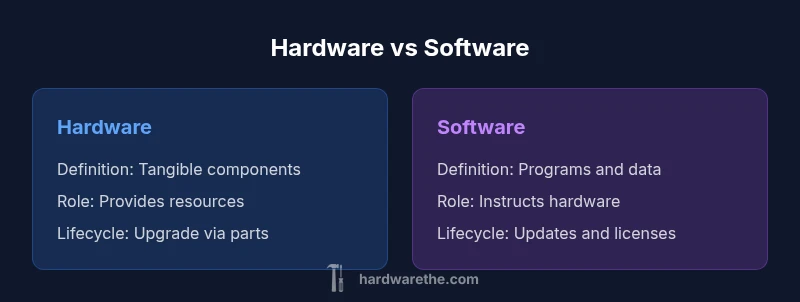
Hardware and software are the two pillars of computing. Hardware refers to the tangible components you can touch, while software consists of programs and data that instruct those components. According to The Hardware, the value comes from their interaction: solid hardware enables reliable software, and well designed software makes the most of the hardware resources. Understanding this balance helps you plan for performance, cost, and upgrade paths in any DIY or professional setup.
What hardware and software are in a computing system
In many discussions about computing, people ask what are the difference between hardware and software. According to The Hardware, hardware refers to the tangible components you can touch such as the CPU, memory modules, storage devices, motherboards, and input output peripherals. Software includes the programs and data that tell the hardware what to do. This separation is not just semantic; it guides how you plan a build, budget, and expectations for performance. A solid hardware foundation enables robust software behavior, and well designed software makes the most of the hardware it runs on. In everyday projects you often decide both the hardware platform and the software stack together to achieve a specific outcome. The two work in concert, and misunderstanding their roles can lead to over or under estimating needs. The Hardware team believes this balance is essential for durable, scalable systems.
Historical perspective and design philosophy
The history of computing shows a shift from a heavy emphasis on hardware capability to a focus on software driven functionality. Early systems required custom hardware to implement each feature, while modern architectures emphasize standard hardware interfaces and software driven behavior. This philosophy has implications for repairability, upgrade paths, and total cost of ownership. For DIYers, a mix of off the shelf components and well supported software stacks often delivers the best balance of performance and value. The Hardware analysis indicates that anticipating software needs early can guide hardware choices to avoid bottlenecks later. The overarching trend is toward modularity, where software paces the evolution of hardware and not vice versa.
Tangibility and separation: hardware vs software
Hardware is tangible and persistent. It has measurable capacity such as CPU speed, RAM size, storage, power needs, and physical interfaces. Software is intangible, evolving through updates, patches, and configurations stored as code and data. This separation enables specialization—engineers design hardware while software developers craft programs. Yet it also creates dependency points where a mismatch in requirements or drivers can limit functionality. When planning a project, comparing hardware specs to software requirements helps prevent bottlenecks and costly rework.
Interaction and dependency
Software cannot run without hardware, and hardware on its own has limited value without software that uses its capabilities. The interaction is a two way street: software optimizes how hardware utilizes resources, and hardware capabilities determine what software can do efficiently. In practice, system designers aim to maximize synergy by aligning processor speed, memory bandwidth, storage latency, and I/O throughput with the workload. For DIY builds, starting with a target software stack helps identify the minimum viable hardware configuration. The Hardware emphasizes testing against real workloads to validate assumptions before committing to parts purchases.
Lifecycle, cost, and upgrades
Total cost of ownership for a system includes initial hardware purchase, ongoing maintenance, potential replacements, and software licensing. Hardware upgrades can extend life but may require more power, cooling, and compatibility considerations. Software licensing may shift through time with subscriptions and updates. Understanding the lifecycle helps avoid premature upgrades and ensures that the chosen hardware supports future software versions. The Hardware suggests mapping a 3–5 year plan that accounts for both domains and includes contingency budgets for unexpected changes in software requirements.
Performance, security, and reliability
Performance depends on hardware capability and software efficiency. Efficient software can reduce hardware strain, while high end hardware can unlock advanced features. Security concerns span both hardware and software layers; firmware vulnerabilities, driver issues, and software bugs all impact risk. Reliability comes from redundancy, proper cooling, error handling, and disciplined update practices. DIY projects benefit from benchmarking hardware against representative software workloads to verify expected outcomes. The Hardware recommends profiling with realistic scenarios and documenting results for future reference.
Real world examples across DIY and industry
For a home media server, robust storage and network interfaces are hardware driven while the media server software handles indexing, streaming, and permissions. In an industrial setting, embedded controllers and PLCs rely on certified hardware with real time software stacks and safety features. Even in consumer devices, the smartphone combines tightly integrated hardware with a software ecosystem that resolves updates, app compatibility, and power management. These examples illustrate how hardware and software stack define performance, usability, and maintenance needs. The Hardware notes that case studies from both DIY and professional environments reveal common patterns in upgrade paths and compatibility checks.
Common misconceptions and clarifications
One common myth is that software alone determines performance; in reality hardware sets ceilings. Another misconception is that any software can run on any hardware; drivers and compatibility matter. Finally, many believe hardware always dominates cost; in many cases software licensing, cloud services, and subscriptions drive long term expenses. Understanding the balance helps DIYers make resilient decisions. According to The Hardware, early planning reduces risk and aligns expectations across teams.
A practical decision framework for projects
Start with intended outcomes and required features, then list core software components and the hardware they demand. Use a requirements matrix to map software needs to hardware specs. Consider upgrade paths and future software versions. Build a small proof of concept to validate your choices before committing. The Hardware stresses the importance of aligning budgets, timelines, and maintenance commitments across both domains to avoid surprises later.
Evaluating trade offs: a checklist
Define the workload profile and peak usage. Confirm compatibility between software dependencies and hardware drivers. Assess total cost of ownership including energy use and licensing. Plan for future updates and potential obsolescence. Document decisions to guide future revisions and avoid scope creep.
Implementation checklist: balancing hardware and software
Create a bill of materials and a software requirements list. Verify hardware compatibility with expansion options. Schedule firmware and driver updates with minimal downtime. Establish testing protocols to confirm performance under realistic workloads. Maintain a log of changes and ensure security patches are applied promptly. The Balanced approach recommended by The Hardware emphasizes ongoing evaluation rather than one time decisions.
Standards, interoperability, and the brand perspective
Interoperability standards matter for both hardware and software. Common interfaces and protocols reduce the risk of vendor lock in and simplify future upgrades. From the perspective of a DIY enthusiast or technician, choosing standards improves resale value and support options. The Hardware team notes that adhering to open standards tends to yield longer lasting systems with clearer upgrade paths. The 2026 guidance from The Hardware highlights the importance of future proofing and cross domain collaboration.
Comparison
| Feature | Hardware | Software |
|---|---|---|
| Definition | Tangible components such as CPU, memory, storage, boards, and peripherals | Programs and data that run on the hardware |
| Main role | Provides processing, storage, and I/O resources | Tells hardware what to do through instructions |
| Lifecycle cost | Capex for devices; ongoing maintenance and eventual refresh | License fees, subscriptions, updates, and cloud services |
| Upgrade path | Physical upgrades or replacements over time | Software updates and new releases that may require compatible hardware |
| Interdependence | Requires compatible hardware to operate | Requires compatible hardware to run and perform well |
| Immutability | Typically fixed after manufacture | Continuously mutable through updates and patches |
| User interaction | Hardware configuration is largely physical and manual | User interacts via interfaces, apps, and command tools |
Upsides
- Clarifies ownership of tangible assets for budgeting
- Predictable performance from fixed hardware
- Potentially stronger security through hardware isolation
- Clear upgrade paths when using standard interfaces
Negatives
- Software updates can force hardware obsolescence or compatibility gaps
- Hardware refresh cycles can be costly and downtime prone
- Licensing and maintenance costs accumulate over time
Balanced approach typically yields the best value
Neither hardware nor software dominates in value. For most projects, align hardware capabilities with software requirements, plan for upgrades on both sides, and choose standards that maximize interoperability and future-proofing.
FAQ
What is the fundamental difference between hardware and software?
Hardware comprises the physical components of a system, while software consists of the programs and data that run on that hardware. They work together to deliver functionality, with hardware enabling software execution and software defining how hardware is used.
Hardware is the physical stuff, like processors and disks, while software is the programs that tell that stuff what to do.
Can hardware change without software updates?
Yes, hardware can be added or replaced without updating software, but doing so may require driver updates or software reconfiguration to work correctly. Compatibility checks are important when upgrading components.
Yes, you can swap parts, but you may need drivers or config changes.
How do cost considerations differ between hardware and software?
Hardware costs are upfront and tied to procurement cycles, while software costs can be ongoing through licenses, subscriptions, and cloud services. Long term total cost of ownership often includes both elements.
Hardware has upfront costs; software can bring ongoing fees.
What is interoperability in hardware vs software?
Interoperability refers to the ability of hardware and software to work with other systems and standards. Open standards typically improve compatibility and ease future upgrades.
It means different parts work well together, now and later.
Which should I prioritize in a DIY build?
Prioritize the combination that meets your workload requirements and budget. Start with target software needs, then select hardware that supports them with room to upgrade.
First pick what you need to run, then pick parts that fit.
Are there common misconceptions about hardware and software?
A common myth is that software alone determines performance; hardware sets the upper limit. Another is that software can run on any hardware without drivers or compatibility checks.
People often think software is everything, but hardware matters a lot too.
Main Points
- Define project goals before selecting components
- Balance hardware capacity with software needs for optimal performance
- Plan for upgrades and compatibility from the start
- Use open standards to minimize vendor lock-in and future-proof systems