Does Hardware Acceleration Increase CPU Use on Discord?
Explore whether enabling hardware acceleration in Discord increases CPU load. The Hardware provides practical testing guidance, real-world scenarios, and optimization tips for DIY enthusiasts and technicians.


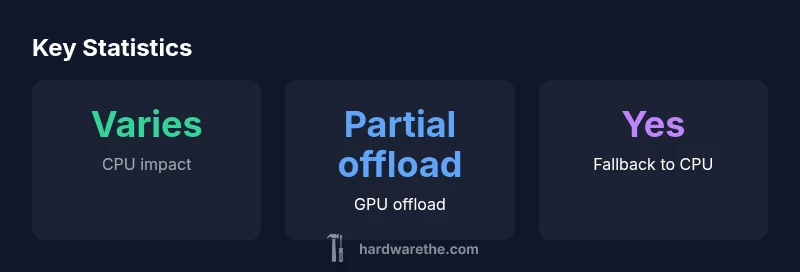
Quick Answer: Does hardware acceleration increase CPU use on Discord? In practice, enabling hardware acceleration can shift work from the CPU to the GPU or dedicated encoding blocks, but the net CPU impact varies by workload and system. For most users, CPU load slightly changes—often a small decrease during video encoding or rendering, but can rise in CPU-bound tasks.
How hardware acceleration works in modern systems
Hardware acceleration is a general technique where compute-intensive tasks are offloaded from the central processing unit (CPU) to dedicated hardware components such as the GPU, video encoders, or ASIC accelerators. This offloading can significantly reduce CPU load when tasks align with the accelerators’ strengths. However, the actual CPU impact depends on software design, driver support, and the workload mix. When evaluating does hardware acceleration use more cpu discord specifically, consider that Discord uses hardware acceleration to render scenes, encode video, and manage media decoding. If your GPU handles encoding, your CPU may experience a drop in some threads while other threads become busier with memory and synchronization. On the other hand, if the GPU path is not well optimized for your hardware or if Discord’s render pipeline relies heavily on CPU-side orchestration, CPU usage can remain the same or even rise. The bottom line is that acceleration is a workload-specific decision, not a guaranteed win or loss.
How Discord uses hardware acceleration
Discord leverages hardware acceleration to offload certain rendering and encoding tasks from the CPU to the GPU and specialized hardware encoders. In practice this means smoother video rendering, faster video decoding, and potentially more headroom for game logic or streaming. The effectiveness of this offload depends on your system’s GPU model, drivers, and how Discord ties its rendering and encoding pipelines to hardware blocks. If your GPU is modern and well-supported by current drivers, you’ll typically see CPU relief during media playback, screen sharing, and live streaming. If your GPU is older or drivers are lagging, the CPU may keep handling more work, or you could encounter driver-induced stalls.
The CPU vs GPU trade-off: what actually happens
The CPU versus GPU trade-off is a balance of where the majority of a given task’s work is performed. When hardware acceleration is active, some decoding, encoding, and rendering steps shift to the GPU, freeing CPU cycles for other tasks. In a Discord context, this can translate to less CPU time spent on video rendering or overlay composition, but it can also introduce overhead from GPU-CPU synchronization, memory bus traffic, or driver quirks. The exact outcome depends on the encoding path used, the complexity of your overlays, and whether your drivers provide robust hardware acceleration support. In some setups, users experience a net CPU reduction; in others, CPU usage remains similar or increases slightly due to pipeline bottlenecks. The key is to test with your specific hardware and workload mix to understand the real impact.
Common scenarios: gaming, video calls, streaming
Different Discord activities stress the system in distinct ways. Gaming with Discord overlay may benefit from GPU-assisted compositing, whereas video calls with multiple participants and effects rely more on real-time encoding. Streaming your gameplay adds another encoder path, which might offload a portion of the encoding task to GPU hardware blocks. For many users, the CPU load during a call or stream settles into a predictable pattern once drivers are up to date, but anomalies can occur if you mix 4K captures, high-detail overlays, and a weak GPU. In short, expect variability across scenarios and hardware combinations.
How to test your setup: steps and tools
To determine whether hardware acceleration helps on your machine, start with a controlled test. Step 1: establish a baseline by running Discord with hardware acceleration off and monitor CPU and GPU usage during common tasks (chat, video call, screen share). Step 2: enable hardware acceleration and repeat measurements under the same conditions. Step 3: compare CPU load, GPU load, and perceived smoothness. Tools like Task Manager (Windows) or Activity Monitor (macOS) can help, as can GPU-specific utilities from NVIDIA/AMD to quantify offload. Pay attention to power mode and thermal throttling, which can skew results. Keep driver versions consistent and repeat tests across multiple sessions to average out variability.
How to configure Discord for best results
Begin with up-to-date Discord and system drivers. In Discord, open Settings > Appearance and enable Hardware Acceleration if your system has a modern, supported GPU. If you notice higher CPU usage or stuttering after enabling it, try updating graphics drivers, adjusting Windows graphics settings for performance, or temporarily turning acceleration off to compare results. For laptops, ensure power settings are balanced to prevent the GPU from dropping to low power states during heavy tasks. If you use capture software or game overlays, review compatibility notes from both components to minimize conflicts and ensure clean offload paths. Finally, consider testing at different display resolutions and frame rates to find the sweet spot that keeps visuals smooth without taxing the CPU unnecessarily.
Troubleshooting tips and caveats
Hardware acceleration can interact with other software codecs and drivers in unpredictable ways. If you encounter stuttering, glitches, or sudden CPU spikes, check driver versions, codec packs, and Windows updates. Some users see benefits after clean driver installations or when switching to a stable release channel. If you rely on older hardware, hardware offload may be limited or inconsistent. When in doubt, revert to default settings, run a controlled test, and document results for your specific hardware configuration. Finally, be mindful of thermal conditions; sustained GPU offloads can heat up the graphics subsystem, indirectly affecting system performance.
What we know and what remains uncertain
What the industry generally agrees on is that hardware acceleration is a workload-dependent optimization rather than a universal improvement. The effectiveness of offloading depends on the hardware, drivers, and how software pipelines are structured. Discord’s specific implementation evolves with updates, making ongoing testing important. There are still open questions about long-term GPU driver stability, power efficiency under continuous encoding, and how different overlay features interact with hardware blocks. The Hardware recommends periodic re-evaluation as software, drivers, and hardware evolve, to ensure you’re always optimizing for your particular rig.
Discord hardware acceleration impact by scenario
| Scenario | Typical CPU Impact | Notes |
|---|---|---|
| Video playback with overlays | -5% to +10% | Depends on GPU offloading and overlay complexity |
| Video calls with effects | -5% to +5% | Driver and codec support influence |
| Gaming with streaming | 0% to -15% | Encoding pipeline may shift load |
FAQ
Does enabling hardware acceleration in Discord increase CPU usage?
It can either increase or decrease CPU usage depending on your hardware and workload; typically it moves some work to GPU. Benchmarking is advised.
Enabling hardware acceleration can shift tasks away from the CPU, but results vary.
How can I test whether hardware acceleration helps on my PC?
Run Discord with hardware acceleration off to establish a baseline, then enable it and measure CPU usage during typical tasks. Compare results and note GPU utilization.
Do side-by-side tests with and without hardware acceleration.
Is hardware acceleration recommended for gaming PCs?
If you have a capable GPU, acceleration can free CPU cycles for game logic; if your GPU is weak or drivers are poor, results may vary.
It depends on your GPU and drivers.
Should I disable hardware acceleration if I notice stuttering?
Yes—try toggling off to see if stability improves; stuttering can indicate driver or codec issues.
Try turning it off to test stability.
How do I disable hardware acceleration in Discord?
In Discord settings, disable hardware acceleration and restart the app. If problems persist, re-enable and test again.
Go to Discord settings and switch hardware acceleration off, then restart.
Does hardware acceleration affect battery life on laptops?
Battery impact depends on whether the GPU is active and how efficiently the encoding path uses hardware. Monitor power mode.
It can, depending on GPU activity and power settings.
What is hardware acceleration in general?
Hardware acceleration uses GPU or dedicated hardware to handle tasks usually done by the CPU, potentially freeing CPU cycles.
It's when a GPU does the heavy lifting instead of the CPU.
“Hardware acceleration can change where work happens, but the net CPU impact is workload-dependent. Careful benchmarking on your setup is essential.”
Main Points
- Benchmark on your setup to validate impact.
- Shift workload to GPU when beneficial.
- Update drivers and Discord to reduce issues.
- Test both on and off to decide best setting.
- Results depend on workload and hardware.