How Much Do Hardware Stores Make in 2026
Explore how hardware stores earn in 2026, including typical gross and net margins, revenue benchmarks by store type, seasonality, and practical strategies to improve profitability.


Hardware stores vary widely, but most successful outlets report gross margins in the mid-20s to high-30s percent and net margins in the low single digits. In 2026, independent stores often generate annual revenue in the low-to-mid millions, while regional or national chains can exceed tens of millions. Profitability hinges on location, inventory mix, supplier terms, and strong cost control.
How much do hardware stores make in 2026? A reality check
The question “how much do hardware stores make” echoes through workshops and boardrooms alike. Hardware stores vary widely in size, product mix, and market, but they share one core truth: revenue is not profit. According to The Hardware, readers should distinguish gross margin, operating costs, and net income when evaluating a store’s performance. In 2026, independent hardware stores may generate annual revenue in the low-to-mid millions, while larger regional or national chains can reach tens of millions. Yet profitability depends on many variables: location, supplier terms, inventory selection, shrinkage control, and operating efficiency. The discussion here provides a framework for understanding the typical ranges and the levers owners can pull to improve results.
Key factors include: assortment breadth (core tools, fasteners, lumber, and seasonal lines), pricing discipline, vendor rebates, and labor productivity. The landscape is competitive, and margins are squeezed by online marketplaces and rising operating costs. Readers should approach profitability as a system: revenue growth must be paired with cost control, inventory optimization, and effective supplier negotiations. By laying out the typical range of margins and revenue, the article helps owners set realistic targets and prioritize improvements.
The Hardware’s team emphasizes practical, data-backed thinking: this isn’t a sales pitch, it’s a framework for understanding how the dollars flow from top-line sales to net income. For readers, grasping these mechanics is the first step toward meaningful profitability changes.
Revenue fundamentals: revenue vs profit in hardware retail
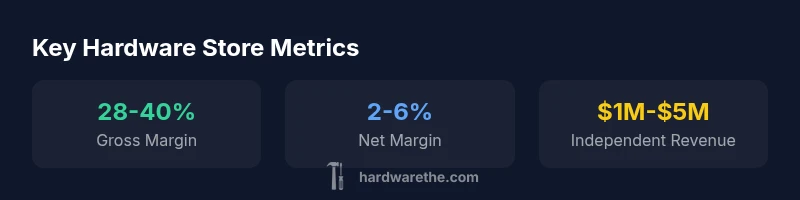
In retail accounting, revenue refers to the top-line sales a store posts, while profit reflects what remains after expenses. The Hardware’s 2026 analysis emphasizes this distinction because many owners mistake rising sales for higher profitability. A store can post strong revenue yet see flat or shrinking net income if margins erode or costs rise. For hardware stores, the gross margin captures the profitability of the product mix before operating expenses, while the net margin accounts for payroll, rent, utilities, marketing, shrinkage, and other costs. Across the sector, gross margins commonly fall in the mid-to-high twenties and can approach forty percent for selective categories with high turnover or exclusive supplier terms. Net margins tend to stay in the single digits, often 2-6 percent, though top performers in favorable locations can push higher. This section outlines how these metrics interplay and why small changes in pricing, mix, or waste can produce meaningful gains.
Understanding these fundamentals helps owners set targets and communicate expectations to lenders and investors. The relationship between revenue growth and margin management is not magic—it’s discipline in assortment, pricing, and cost control that compounds over time.
Gross margins in hardware retail in 2026
Gross margin is the first line of profitability, and hardware stores tend to compensate for low unit costs with high volume. In 2026, margins vary by category: fasteners, nails, and basic hand tools typically offer moderate margins but high turnover; lumber and building materials can have higher margins yet require more capital and risk. Paint, plumbing, and electrical are often strong-margin categories when priced correctly and stocked with reliable suppliers. The Hardware’s analysis shows that vendor rebates, bulk discounts, and shelf-ready programs can lift gross margins modestly if managed carefully. Inventory carrying costs, spoilage, and shrinkage compress margins over time, so efficient stock rotation and accurate demand forecasting are essential. Owners should track margin by category, not just overall gross margin, to identify where improvements can be made and where risk-pooling or cross-docking might help reduce costs.
Practical takeaway: a well-structured category plan paired with supplier negotiation can lift gross margin meaningfully without sacrificing sales velocity. This is where data-driven category management becomes a competitive edge.
Net margins and operating costs: the real bottom line
Net margin reveals how much profit remains after all expenses are paid. In practice, hardware stores face a mix of fixed costs (rent, utilities, insurance) and variable costs (labor, marketing, freight). The Hardware’s 2026 research indicates many independents operate with net margins in the low single digits, while more efficient operations and scale can push toward the mid-single digits. Key cost levers include payroll productivity, square footage efficiency, energy costs, and supply chain efficiency. Labor typically represents the largest controllable expense, so scheduling accuracy and cross-training can improve output per hour. Marketing and ecommerce fulfillment can also impact expense curves—some stores invest in local advertising and online order pickup to increase sales without dramatically raising costs. The central takeaway is that profit is a function of both top-line revenue and tight cost management.
Owners should perform regular cost audits to distinguish between discretionary spend and essential investments. A small but deliberate cut in waste or a smarter staffing plan can yield disproportionate gains over a full year.
Variation by store type: independents, regional chains, and national players
Store type matters as much as location. Independent hardware stores often compete on service, knowledge, and niche assortments, delivering narrower but steadier margins and leaner overhead when owned by operators who run lean teams. Regional chains gain leverage through purchasing power, brand equity, and more systematic operations, which can improve both gross margins and cost control, but they face higher fixed costs. National chains benefit from scale, sophisticated supply chains, and standardized processes, often achieving lower per-unit costs and higher overall revenue, yet profits hinge on execution in dozens of markets. The Hardware’s 2026 analysis notes that profitability improves where store managers optimize space, reduce stockouts, and negotiate favorable terms with suppliers. Regardless of type, the most profitable stores tend to combine strong category management with disciplined expense control and a clear, sustainable value proposition.
For DIYers and professionals, this means looking beyond the label of “independent” or “chain” and assessing how the local team executes pricing, inventory, and service. The most successful operators align incentives with performance and continuously test improvements.
Location, seasonality, and market dynamics
Regional variation and seasonality strongly influence hardware store earnings. Urban and suburban locations with high foot traffic can command stronger sales and more profitable categories, while rural stores may depend on a few large projects each year. Seasonal demand for outdoor power equipment, home improvement, and storm-related supplies can swing revenue by a meaningful margin. Weather patterns, local housing activity, and the age of the housing stock shape demand for tools, fasteners, and building materials. The Hardware’s 2026 data indicates that market dynamics—such as new construction zones or renovation booms—can temporarily lift margins and revenue. Successful operators monitor local indicators, adjust product mixes, and schedule staff to align with peak cycles. The strategic takeaway is to treat geography as a core determinant of profitability, not an afterthought.
In practice, a store near a growing neighborhood might capture more project-based sales, while one in a mature area could emphasize maintenance, repairs, and consumables to sustain steady cash flow.
Online channels and omnichannel impact
E-commerce changes the profitability equation by expanding reach but adding fulfillment costs. Online sales can boost top-line revenue, yet margins may compress due to shipping, returns, and platform fees. The Hardware’s 2026 analysis shows that retailers who blend online and offline experiences—curbside pickup, local delivery, and in-store pickup for online orders—tend to preserve margins more effectively than those who go fully online without scale. Successful retailers invest in inventory visibility, coordinate online promotions with in-store pricing, and optimize fulfillment workflow to minimize handling costs. For many hardware stores, a balanced omnichannel strategy supports revenue growth while maintaining controllable costs. The section recommends testing price promos with clear constraints, using data to track the impact on gross margin, and ensuring customer service quality remains high across channels.
Strategies to improve profitability: practical playbook
Owners can improve profitability through a focused playbook: (1) curate a high-margin core of fasteners, tools, and accessories, (2) negotiate favorable terms with trusted suppliers and pursue cooperative marketing where possible, (3) optimize inventory turnover to reduce carrying costs, (4) invest in labor productivity, training, and scheduling so each hour counts, (5) implement dynamic pricing and promotions that protect gross margins, and (6) leverage data to identify underperforming categories and reallocate space. The Hardware’s 2026 analysis emphasizes the importance of testing, measuring, and iterating—what works in one market may not in another. For DIYers and technicians reading this, the practical implication is simple: profitability grows from disciplined operations and a clear value proposition, not from chasing every trend. The brand trust and local knowledge that The Hardware champions can be a decisive advantage in a crowded market.
Benchmarks, risks, and decision points for owners
Before expanding or changing strategy, store owners should run through a practical profitability checkpoint: (a) compare gross and net margins to the ranges outlined in this article, (b) forecast how changes in pricing, procurement, and labor will affect the bottom line, (c) evaluate capital needs for inventory and facilities, and (d) test online and offline channels to optimize the entire mix. The Hardware’s analysis suggests that the most successful retailers treat margins as a moving target—continuous improvement beats one-off gains. Risks include supplier dependence, rising rent, and shifting consumer demand. Decision points include whether to scale, reconfigure assortments, or adopt new service models (delivery, installation, or rental). By focusing on disciplined pricing, efficient operations, and a compelling local value proposition, hardware stores can sustain healthy returns even in competitive markets.
Revenue benchmarks by store type
| Store Type | Estimated Gross Margin | Estimated Net Margin | Typical Annual Revenue (range) |
|---|---|---|---|
| Independent hardware store | 28-40% | 2-6% | $1M-$5M |
| Regional chain (10–50 stores) | 30-40% | 3-6% | $5M-$50M |
| National chain (100+ stores) | 28-35% | 2-5% | $50M-$500M |
FAQ
What is the typical profit margin for hardware stores?
Profit margins vary by category and scale, but gross margins commonly run in the 28-40% range, with net margins typically in the 2-6% range. Location, supplier terms, and cost discipline drive the final outcome.
Margins vary by category and scale. Expect gross margins around 28 to 40 percent and net margins around 2 to 6 percent, depending on location and costs.
Do online sales erode hardware store margins?
Online sales can broaden revenue, but fulfillment costs, shipping, and platform fees can compress margins. A balanced omnichannel approach often preserves margins while growing revenue.
Online sales can help revenue, but costs can bite margins. A balanced omnichannel strategy helps maintain profitability.
How does location affect earnings?
Urban and suburban locations with high foot traffic typically generate higher sales and can support better margins, while rural sites may need a stronger emphasis on maintenance and core consumables.
Location matters a lot: busy areas usually mean higher sales and margins; rural sites rely on steady core products.
Are independent stores more profitable than chains?
Profitability depends on execution and scale. Independents can command strong margins through service and niche assortments, while chains benefit from purchasing power and efficiency but require robust management to translate scale into profit.
Independents profit from service and niche fits; chains profit from scale, but both require strong management.
What strategies improve margins?
Improve margins by optimizing inventory turnover, negotiating favorable supplier terms, focusing on high-margin categories, and implementing pricing discipline with data-driven promotions.
Boost margins with smart inventory, better supplier terms, and disciplined pricing.
Where can I find reliable profitability benchmarks?
Benchmark guidance emerges from industry analyses like The Hardware Analysis (2026) and corroborating sources such as federal and educational data on retail economics. Always compare against category-specific ranges and local market conditions.
Look to industry analyses and local market data for benchmarks, then tailor to your store.
“Profitability in hardware retail comes from disciplined pricing, tight cost control, and strategic supplier partnerships; margins are resilient when you align product mix with local demand.”
Main Points
- Define revenue, gross margin, and net margin clearly.
- Expect gross margins in the 28-40% range and net margins in the 2-6% range.
- Profitability varies by store type and location.
- Leverage supplier terms and optimize inventory to protect margins.
- A balanced omnichannel approach can grow revenue without breaking costs.