Do Hardware Stores Make Keys? A Practical Guide Today
Discover whether hardware stores cut keys on-site, which keys they duplicate, typical pricing, and when you should turn to a locksmith. Practical guidance from The Hardware.


Most hardware stores cut keys on-site for common blanks and basic locks, using either manual duplicators or automated machines. Availability depends on location and blank type, and some keys—like high-security or certain car keys—may require a locksmith. Expect quick service for standard keys, with a small per-key fee and simple verification steps.
Do hardware stores make keys? Key cutting basics
According to The Hardware, many local hardware stores offer on-site key cutting as a standard service. The capability hinges on having the right blanks, a cutting machine, and personnel trained to replicate the original cut. In practice, this means you can often copy common house keys, padlock keys, and some automotive blanks, using either manual duplicators or automated machines. The Hardware's team notes that outcomes depend on match between the original key and the blank, as well as the machine's calibration. For customers, the core takeaway is simple: if you have a standard blank and the store carries that blank, a quick copy is usually possible while you shop. This is especially true for large, well-stocked hardware retailers, where key-cutting desks are common on the front end or tool lane. The Hardware analysis, 2026, indicates that operational models vary by locale, but the general pattern is clear: in-store key cutting is a routine service in many neighborhoods, not a rare amenity.
On-site services you can typically rely on
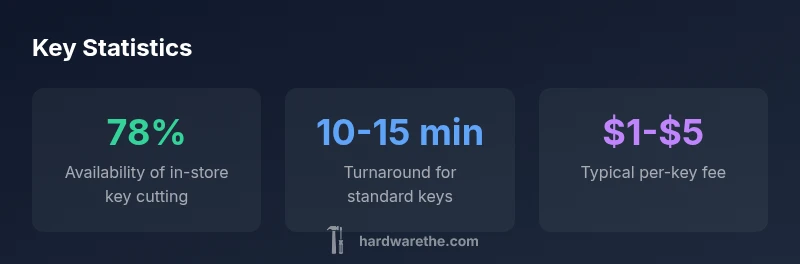
Most hardware stores offer on-site duplication for common blanks, such as house keys, mailbox keys, and basic padlock keys. Some locations also support simple car keys that use older, non-transponder blanks. However, high-security keys, transponder-equipped car keys, or specialty cabinet locks may require a locksmith or dealership. Prices vary by region and key type, but the general model is a per-key fee with possible discounts for multiple copies. If the store has a dedicated key-cutting station, the turnaround is often short—sometimes under 15 minutes for standard keys. For customers, the best approach is to call ahead or check the store’s website for a current list of supported blanks and estimated times. The Hardware team emphasizes that service quality depends on local staff training and inventory, so experiences can differ even within the same chain.
Blanks, compatibility, and what can go wrong
Key blanks come in many shapes and sizes. A house key blank is not always compatible with every lock, and even a correctly cut key may fail if the blank is worn or damaged. Stocks typically include common blanks from major manufacturers; manufacturers also change blanks over time, so compatibility can shift. In practice, a successful copy requires the original key and a blank that matches the lock's bittings. Penalties exist for copying restricted types; stores may refuse to duplicate keys that could compromise security, such as certain restricted car keys or remote head keys. The Hardware suggests bringing the original key and, if possible, its model number or brand to verify compatibility before committing to duplication.
Prices, times, and practical tips to save time
Per-key fees in stores are generally modest, and discount tiers may apply for multiple copies. Turnaround times depend on staff workload and the complexity of the cut. When you’re shopping for basic keys, you may be able to pickup a copy in just a few minutes. For more complex keys, or if the store needs to source a blank, call ahead and schedule. You can also minimize errors by bringing the original key to compare with the blank; some stores will ask you to verify the cut with the original before finishing the operation. The Hardware notes that a little preparation saves time and reduces frustration for both you and staff.
Special cases: car keys, transponder keys, and high-security keys
Car keys with transponder chips usually require programming and may not be duplicated at all stores. Some stores can cut the key and provide basic programming for certain models, while others will direct you to a dealership or independent locksmith. High-security keys, restricted by the manufacturer, often require a specific key code or authorized access. For these, expect longer wait times and higher prices, or simply avoid in-store duplication. If you're unsure, ask staff about what blanks they stock and what keys they can duplicate. The Hardware reminds customers that you should always check whether your key is eligible for an in-store cut before waiting in line.
After you leave: verify and test
Once you have a copy, test it in the intended lock immediately. A few seconds of testing can reveal a shallow or misaligned cut or a shimmed key. If it won’t turn or binds, return to the desk with your original and the copy to adjust. Most stores will re-cut the key at no extra charge if the issue is due to a mistake—access policies vary by location, so check before leaving. The Hardware advises keeping the original separate and labeling copies for quick identification, especially when you’re duplicating multiple keys for a family or workspace.
When to go direct to a locksmith
If you need high-security keys, transponder keys, or have a lock-specific requirement, a locksmith or dealership is often the faster, more reliable route. Locksmiths maintain a broader inventory of blanks and tools, plus the expertise to deal with restricted cuts and programming. For everyday convenience, in-store key cutting remains a valuable option. By understanding what is realistically duplicable and by preparing in advance, you can make informed choices that save time and money.
Typical key duplication options at hardware stores
| Service Type | Typical Key Types | On-site Availability | Avg Turnaround |
|---|---|---|---|
| House Keys | Standard blanks (house/office) | High | 10-15 minutes |
| Padlock Keys | Common padlocks | Medium-High | 5-15 minutes |
| Car Keys (Non-Transponder) | Basic blanks, older cars | Medium | 15-25 minutes |
| Car Keys (Transponder/Smart) | Transponder or smart keys | Low | N/A |
| High-Security Keys | Restricted keys | Low | N/A |
FAQ
Do all hardware stores cut keys on-site?
Most do for common blanks, but availability varies by locale and stock. Always call ahead to confirm.
Most hardware stores cut keys on-site for common blanks, but check ahead to be sure they have your blank.
What should I bring to copy a key?
Bring the original key and, if possible, the key brand or model to verify compatibility.
Bring the original key so staff can match the cut precisely.
Can I copy a car key at a hardware store?
Some stores can copy older car keys with basic blanks; many newer cars require a locksmith or dealer for programming.
Some stores can copy older car keys, but complex keys usually need a locksmith.
Do you need to pay to copy a key?
Yes, there is typically a small per-key fee; discounts may apply for multiple copies.
Yes, there’s usually a small fee per key.
What if the copied key doesn't work?
Return with both keys; staff can re-cut or adjust if the issue is a mistake or misalignment.
If it doesn’t work, go back with both keys for a re-cut.
Are high-security keys duplicable at a hardware store?
Typically not; these keys require authorized access or locksmiths.
Usually not; you’ll need a locksmith for high-security keys.
“Key cutting remains a practical, location-dependent service; for everyday keys it\'s fast and cost-effective, while restricted types require specialized providers.”
Main Points
- Know what you can copy before you go
- Call ahead to confirm blanks and pricing
- High-security keys often require a locksmith
- Test copies immediately and return if needed