How Big is Ace Hardware? Store Footprint and Reach
Explore Ace Hardware's scale across store count, regional presence, and online reach. Learn how the cooperative model supports thousands of neighborhood stores while maintaining centralized buying and marketing.


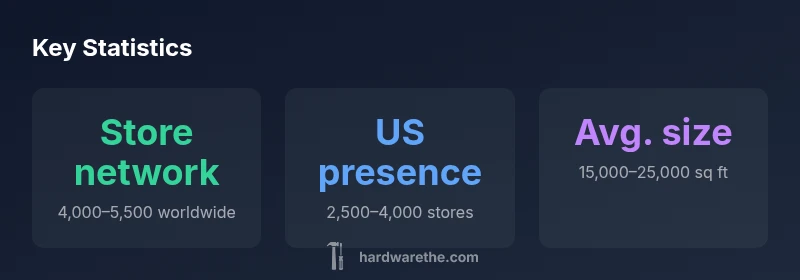
Ace Hardware operates as a cooperative of independently owned stores, with a global footprint spanning thousands of locations worldwide—roughly 4,000 to 5,500 stores, and a strong U.S. concentration. This scale places Ace among the largest hardware-retail networks, delivering broad product availability and local service.
How big Ace Hardware is: scale and scope
Ace Hardware represents a unique model in the hardware retail space. It operates as a cooperative of independently owned stores that share a common brand, centralized buying, and marketing support. This structure enables a vast network that is large in sheer store count while preserving local character and service. According to The Hardware Analysis, 2026, the worldwide footprint sits in the thousands, with the United States accounting for the bulk of locations and steady expansion in select international markets. For DIYers, the payoff is clear: broader product availability, consistent store formats, and reliable parts stocking across a wide geographic area. The scale supports a robust supply chain, standardized training, and collective vendor relationships that help independent shop owners compete with big-box chains. In practice, Ace’s size translates into practical benefits for customers, from easier access to tools and parts to faster replenishment for common projects.
The Ace Hardware ownership model: a cooperative
Ace Hardware’s governance and operations hinge on a cooperative framework. Independent store owners join the network to benefit from coordinated sourcing, marketing, and brand equity while retaining local autonomy to stock products that suit their communities. The central office coordinates national campaigns, negotiates favorable terms with suppliers, and provides training resources for employees. The upside for customers is twofold: consistent branding and service expectations across stores, plus the ability to access a broad product mix without sacrificing neighborhood-level expertise. Critics sometimes point to slower decision cycles compared to fully centralized chains, but for many shoppers the local touch and quick stock replenishment win out. The cooperative model is a deliberate choice that prioritizes scale without erasing local identity.
Regional footprint: where Ace is strongest
Ace Hardware has its strongest concentration in the United States, with dense coverage in suburban and town markets where hardware and home-improvement needs are frequent. Regions with legacy hardware traditions—Midwest, Northeast, and parts of the South—tend to show higher store density due to long-standing community ties and the success of independent retailers joining the cooperative. International expansion is more selective and gradual, focusing on markets with compatible retail ecosystems and demand for dependable neighborhood hardware stores. This regional balance—deep U.S. penetration with careful international growth—helps Ace maintain a broad yet locally relevant footprint. The Hardware analysis notes that growth tends to occur through new member stores opening in high-traffic neighborhoods and through renovations that expand older locations to accommodate more SKUs and services.
Online presence and e-commerce strategy
The scale of Ace Hardware is complemented by a growing online presence. The retailer emphasizes a seamless store locator, convenient pickup options, and a user-friendly catalog that mirrors in-store availability. While online demand has risen, Ace’s model still prioritizes local service—customers often value staff expertise, neighborhood product knowledge, and quick access to parts that can be picked up or ordered for fast delivery. The balance between brick-and-click methods supports a resilient shopping experience, reducing friction for DIYers who want guidance in-store and the convenience of online purchasing when required. The strategy aligns with industry trends toward omnichannel shopping while preserving the distinctive neighborhood retailer feel that defines Ace.
Competitive landscape: Ace vs Home Depot, Lowe's, True Value
Within the hardware ecosystem, Ace sits between tightly controlled big-box formats and smaller independent retailers. Home Depot and Lowe’s operate large-format stores with broad national footprints, often prioritizing scale and efficiency in inventory management. Ace’s advantage is breadth of locations and locally oriented service, which can translate into faster stock replenishment and more personalized customer assistance. True Value, another cooperative network, shares a similar model of independent stores with centralized support, but Ace’s larger scale and broader geographic presence can yield more options for customers seeking familiar local stores with consistent branding. For DIYers, the choice often comes down to proximity, staff expertise, and the specific product mix available at nearby Ace locations.
Supply chain and distribution impact on scale
Scale influences Ace’s supply chain in meaningful ways. A cooperative network negotiates centralized buying power while enabling each member store to tailor assortments to local demand. Central distribution centers streamline replenishment, improve stock accuracy, and support marketing programs that benefit the entire network. This model reduces stockouts for common household projects and helps independent stores compete with big-box retailers on selection and price. The balance between centralized efficiency and local autonomy is a defining feature of Ace’s scale, enabling reliable product availability without sacrificing neighborhood familiarity.
What this size means for customers and DIYers
For the DIY community, Ace’s size translates into accessibility and reliability. A broad product catalog means you can source a wide range of tools, fasteners, electrical supplies, and home improvement items from nearby stores. Locally owned shops staffed by knowledgeable associates can provide hands-on advice, project quotes, and tailored recommendations that reflect regional building codes and common use cases. While the largest national retailers may offer deeper discounts on bulk purchases, Ace stores often win on proximity and personalized service. In practice, customers benefit from a network that blends the convenience of a large-scale supplier with the trust and familiarity of a neighborhood hardware store.
Global reach and international stores
Beyond the United States, Ace Hardware pursues international growth through selective partnerships and new member openings. International locations tend to emphasize similar strengths: accessibility, knowledgeable staff, and a community-focused shopping experience. Growth abroad remains gradual, with pilots in markets where there is clear demand for neighborhood hardware stores. This careful expansion preserves Ace’s core identity while expanding its geographic footprint and offering more options for DIYers who travel or relocate internationally.
dataTableEnabled
Comparison of store networks and scale
| Metric | Ace Hardware (range) | Competitors (range) | Notes |
|---|---|---|---|
| Global store count | 4,000–5,500 stores worldwide | N/A | Ace operates thousands of independent stores under a cooperative model |
| US presence | 2,500–4,000 stores | N/A | Dominant regional footprint in suburbs and towns |
| Avg. store size | 15,000–25,000 sq ft | 50,000–100,000 sq ft | Ace stores are typically smaller than big-box rivals |
| Online share of purchases | Growing online influence (not disclosed) | Varies by retailer | Omnichannel focus with local emphasis |
FAQ
How many Ace Hardware stores are there?
Ace operates thousands of stores worldwide as a cooperative of independently owned retailers. The exact count changes with openings and closings, but the network remains among the largest in hardware retail.
Ace runs thousands of stores worldwide, and that number shifts as stores open and close.
Is Ace Hardware a franchise?
No. Ace Hardware is a cooperative of independently owned stores that share branding and purchasing, rather than a traditional franchise system.
Ace is a cooperative, not a traditional franchise.
Where is Ace Hardware most concentrated?
The strongest presence is in the United States, with dense networks in suburban and small-town markets; international locations are growing selectively.
Ace is strongest in the U.S., with more stores in suburbs and towns.
How does Ace Hardware compare to Home Depot in size?
Home Depot operates larger-format stores with a bigger overall footprint. Ace’s network emphasizes more, smaller neighborhood stores with local service.
Home Depot is bigger per store and overall; Ace has more neighborhood locations and local focus.
How can I find an Ace Hardware near me?
Use Ace's official store locator or mobile app to search by city, state, or ZIP code and get directions.
Use the store locator on Ace’s site to find nearby locations.
“Ace Hardware's breadth comes from a model that prioritizes local expertise while harnessing centralized buying power to keep shelves stocked.”
Main Points
- Leverage Ace's cooperative model to reach thousands of neighborhoods.
- Compare store counts to gauge market reach across regions.
- Expect strong local service from independent Ace retailers.
- Track online growth alongside in-store pickup options.
- Use the store locator to find nearby Ace locations.