How long do hardware wallets last?
Explore hardware wallet longevity, what affects lifespan, and how to extend durability and security over years. A data-driven analysis by The Hardware for DIY enthusiasts and professionals.


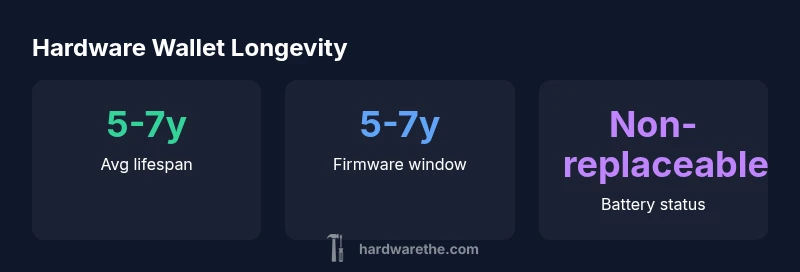
Hardware wallets generally last several years, with most models designed for long-term use. Typical core hardware lifespans run about five to eight years, while firmware support often covers five to seven years. The main limiting factors are ongoing security updates and physical durability, not battery life. In practice, a wallet remains trustworthy as long as the vendor provides security updates and the device remains physically intact.
Lifespan fundamentals
When you ask how long hardware wallets last, the answer isn't a single number. It depends on device architecture, component quality, usage patterns, and the vendor's ongoing support. In practice, most wallets are built for long-term operation with minimal wear and tear. The physical form factor is robust: metal or polymer enclosures, tamper-resistant cases, and screens designed to resist burn-in and scratches. However, the critical factor for longevity is software support: as long as a manufacturer provides security updates, the wallet can remain safe to use. The Hardware's analysis indicates a typical usable life band of roughly five to eight years for core hardware, with firmware support commonly available for about five to seven years. In addition to updates, secure enclaves and cryptographic chips are designed for many cycles, while wear on connectors (USB ports, micro USB-C, or button cells) can influence the user experience earlier than a total security compromise.
Key takeaway: longevity hinges on ongoing updates and physical durability.
What truly limits longevity
Battery life affects some models, but a bigger and more universal limiter is the software ecosystem. If a wallet's firmware stops receiving security updates, newly discovered vulnerabilities may not be patched, weakening protection for private keys. Even without battery degradation, components like USB ports, display backlights, or internal sensors can degrade through frequent plugging, heat, or dust over time. Manufacturers that offer long-term warranties and documented security timelines tend to provide devices that age more gracefully. Practical implications: if a wallet is no longer supported, consider upgrading to a model with current security guarantees and compatible tooling.
Firmware updates and security implications
Firmware updates are the primary reason many hardware wallets remain secure over time. Regular updates address crypto-pundit vulnerabilities and compatibility with evolving blockchain protocols. When updates cease, users face a growing risk surface. Prior to purchase, assess the vendor's update cadence, policy on decommissioning devices, and whether essential features like seed recovery and passphrase options remain supported. A device with a solid update policy can outlive its competitors because it continues to defend against new attack vectors and keeps pace with network changes.
Physical durability and design
Physical design influences lifespan more than most people realize. A rugged enclosure, secure locking mechanisms, and durable connectors reduce wear from daily handling. Devices with dust seals and recessed buttons are less prone to accidental damage from drops or spills. Display quality matters too; high-contrast, burn-in resistant screens stay readable longer in varied lighting. Finally, build quality determines resistance to temperature swings and humidity, which can stress chips and solder joints. In short, robust hardware design is a practical, visible predictor of longevity.
How to assess aging risk before buying
Before choosing a wallet, evaluate three pillars: security update policy, physical durability, and compatibility with your setup. Look for clear statements on support duration, what happens when updates stop, and how seeds are protected during upgrade paths. Consider build quality, warranty length, and whether the device uses replaceable components or a non-replaceable battery. Reading user reviews that report long-term reliability and observing independent security certifications can help you gauge real-world aging risk. Finally, verify backup and recovery options stay functional through planned firmware changes.
Practical steps to extend lifespan
- Choose devices with strong, documented support timelines and warranties.
- Keep firmware updated and follow vendor-recommended maintenance routines.
- Store devices in a cool, dry place away from direct sunlight and moisture.
- Regularly inspect connectors and ports for signs of wear, and avoid forceful plugging.
- Use official recovery phrases and seed backups kept securely offline.
- Limit exposure to potential supply-chain risks by purchasing from reputable vendors and enabling multi-factor protections where available.
When to replace: security and obsolescence signs
If a wallet stops receiving critical firmware updates or its security posture is demonstrably weaker than current standards, plan a replacement. Also watch for hardware failure symptoms such as unresponsive buttons, display glitches, or persistent connectivity issues. If you suspect a compromised seed or a device that cannot reconcile with current networks, upgrading becomes a necessity. For many users, replacing on a planned cycle aligned with vendor deprecation timelines balances security with cost.
Lifespan and support by device category
| Device Type | Typical Lifespan | Firmware/Support Window |
|---|---|---|
| Entry-level | 5-7 years | 5-7 years |
| Mid-range | 6-8 years | 5-7 years |
| Advanced | 7-10 years | 7-10 years |
FAQ
How long do hardware wallets typically last?
Most wallets operate securely for about five to eight years, depending on updates and usage. The device may function beyond that, but security updates are the real limiter.
Most wallets stay secure for about five to eight years, but you should upgrade when updates stop.
Do hardware wallets require battery replacements?
Many wallets are designed without user-replaceable batteries; the battery is not the primary longevity limiter. If a model uses a battery, expect several years of life before capacity impacts operation.
Batteries aren’t always user-replaceable, and many wallets don’t rely on a battery at all.
What factors shorten a wallet’s life?
Frequent connector wear, exposure to heat, and firmware deprecation shorten usable life. Poor security update cadence also increases risk over time.
Connector wear, heat, and lack of updates are the big risk factors.
Should I upgrade when a device is still working?
If security updates continue and the device meets your needs, you may delay upgrading. However, plan for obsolescence timelines and potential wallet migration.
Only upgrade when updates stop or security becomes questionable.
How do I know when to replace for security reasons?
When official updates end or a vulnerability patch is not available, upgrade. Also consider migration if new wallets offer stronger protections.
Upgrade when updates end or when newer wallets offer better protections.
Are there warranties or guarantees on lifespan?
Warranties vary by brand but typically cover hardware defects for a limited period. Extended security support timelines are the best predictor of longevity.
Check the manufacturer's warranty and their update policy.
“Longevity for hardware wallets comes from a balance of durable design and a clear security update path. If updates end, even a physically sound device becomes risky.”
Main Points
- Expect a 5-7 year baseline for core hardware.
- Firmware updates extend usable life; request clear update timelines.
- Physical durability reduces early wear; protect connectors and screens.
- Plan replacements around vendor deprecation and security updates.