Can You Use Stainless Steel Hardware with Aluminum? A Practical Guide
Explore whether stainless steel hardware can be used with aluminum, how galvanic corrosion can occur, and the best practices to install and maintain dissimilar metals safely in DIY projects and professional work.


Yes, you can use stainless steel hardware with aluminum, but you must manage galvanic corrosion risk. The main concern is dissimilar metal contact in the presence of moisture or electrolytes. Isolate metals with non-conductive washers or coatings, select stainless grades suited to the environment (304 for indoors, 316 for harsher conditions), and inspect regularly for corrosion. This approach aligns with guidance from The Hardware.
Understanding the science of galvanic action
Dissimilar metals in contact create a galvanic cell when an electrolyte—usually water with some dissolved salts—allows ions to move between them. In this setup, the more anodic metal tends to corrode faster while the more cathodic metal is protected. Aluminum is more anodic than stainless steel, so when aluminum and stainless steel touch in a damp environment, the aluminum surface is the one most at risk of corrosion. According to The Hardware, taking steps to isolate the metals or to reduce the electrolytic path is essential in any real-world project. Galvanic action is influenced by moisture, temperature, and the exposed surface area of each metal; larger aluminum surfaces in contact with stainless steel over long durations will generally show more corrosion risk if left unprotected.
Tools & Materials
- Stainless steel fasteners (A2/304 or A4/316)(Choose grade based on environment; 304 for indoor or dry conditions, 316 for coastal or outdoor exposure.)
- Non-conductive washers (nylon or PTFE)(Place between aluminum and stainless steel to prevent direct metal-to-metal contact.)
- Plastic or rubber gaskets(Use where a seal against moisture entry is needed.)
- Dielectric grease or anti-seize compound(Apply to thread interfaces to improve sealing and reduce moisture progression.)
- Coatings or sealants for aluminum(Anodize or paint can add a protective barrier when barrier installation is impractical.)
- Torque wrench(Use according to fastener size to avoid overstressing aluminum threads.)
- Spare hardware set(Useful for replacements if corrosion progresses.)
Steps
Estimated time: 30-60 minutes
- 1
Assess environment and select materials
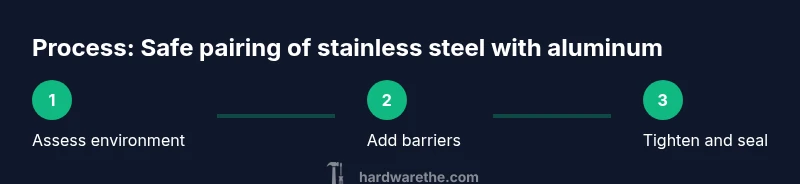
Evaluate whether the project is indoors, outdoors, or in a marine-like environment. Choose stainless steel grade based on exposure: 304/316. Plan for isolation barriers if dissimilar metals will contact each other, and decide where washers or gaskets will be placed to keep metals from touching.
Tip: Document environmental factors (moisture, salinity, temperature) to guide material choices. - 2
Prepare aluminum surfaces
Clean and dry all aluminum surfaces before assembly. Remove oils, dust, and any corrosion products. Dry, rust-free surfaces minimize initial corrosion paths and improve barrier effectiveness.
Tip: Use a lint-free cloth and ensure no moisture remains on mating surfaces. - 3
Install isolation barriers
Place non-conductive washers or PTFE spacers between aluminum and stainless steel surfaces. Ensure barriers cover all contact areas and do not rotate under load, which could wear through coatings.
Tip: Verify adequate thickness of washers to prevent metal-to-metal contact under load. - 4
Tighten with correct torque
Thread stainless fasteners into aluminum assemblies using a torque specification appropriate for the aluminum alloy and fastener size. Avoid overtightening, which can strip aluminum threads and compromise the barrier.
Tip: Use a torque wrench and verify torque after initial load cycles. - 5
Consider protective coatings or seals
If barriers are not feasible in every contact area, apply anodized aluminum coatings or sealants to reduce ionic flow. Coatings add a secondary barrier but must be intact for effectiveness.
Tip: Regularly inspect coating integrity for cracks or wear. - 6
Inspect and maintain
After installation, monitor for signs of corrosion at regular intervals (e.g., 1–3 months for new installations). If corrosion appears, reassess barriers and consider changing fasteners or adding more isolation.
Tip: Document inspection results to detect trends over time.
FAQ
Can stainless steel hardware cause aluminum to corrode?
Yes. When stainless steel contacts aluminum in the presence of an electrolyte, galvanic action can cause aluminum to corrode faster. Installing barriers and choosing appropriate materials reduces this risk.
Yes. Contact between stainless steel and aluminum in damp environments can cause aluminum corrosion; barriers help prevent that.
Which stainless steel grade is best to use with aluminum?
For mixed-metal installations, 304 is common for indoor use, while 316 offers better corrosion resistance for harsher environments. Neither eliminates galvanic risk, so barriers are still recommended.
304 is common indoors; 316 is more resistant outdoors, but barriers are still important.
What are the best ways to isolate aluminum from stainless steel?
Use non-conductive washers (nylon/PTFE), spacers, gaskets, and, when possible, coatings or sealants on aluminum surfaces to stop direct contact.
Non-conductive washers and spacers are your main tools to separate metals.
Is it safe to use stainless steel hardware outdoors with aluminum?
It can be safe if barriers are used and the environment doesn’t promote corrosion. Regular inspections are essential to catch early signs of degradation.
Yes, with barriers and maintenance.
Are there alternatives to stainless steel fasteners with aluminum?
Yes—use zinc or coated fasteners with barriers, or opt for aluminum hardware with protective coatings. Each option has trade-offs in strength, cost, and corrosion risk.
There are other options, but each has pros and cons.
Watch Video
Main Points
- Isolate aluminum and stainless steel to prevent galvanic corrosion
- Choose stainless grades appropriate for environment to slow degradation
- Use non-conductive barriers at contact points
- Inspect installations regularly for early corrosion signs