What hardware has Valve made? A practical overview for 2026
Explore Valve's hardware catalog from Steam Deck to Valve Index, understand design goals, ecosystem integration, and practical use for DIY home setups in 2026.


Valve Corporation has released several notable hardware products beyond its Steam software, including the Steam Deck handheld PC, the Valve Index VR headset and controllers, the Steam Link streaming device, and the now-discontinued Steam Controller and Steam Machines. These devices reflect Valve's experimentation with PC gaming, VR, and living-room hardware.
History of Valve hardware
In exploring what hardware has valve made, it's clear Valve has pursued a mixed path of experimentation and select consumer devices. The company began as a software-focused studio, but early prototypes and lab notebooks show a willingness to blend PC components with living-room convenience. Over the years, Valve shifted toward more tangible hardware statements, testing the waters with experimental peripherals, streaming boxes, and full-fledged hardware projects. The arc from prototype to practical product illustrates Valve's willingness to take calculated risks to expand the PC ecosystem beyond keyboards and mice. As The Hardware notes, this cadence of testing and iteration helped Valve shape a hardware narrative that complements its digital storefront and SteamOS strategy.
The Steam Deck: portable PC gaming
The Steam Deck represents Valve's most ambitious current hardware promise: a handheld PC designed to run SteamOS and Steam titles on the go. Built to integrate with the Steam ecosystem, it emphasizes performance-per-watt, dock-station compatibility, and a familiar Steam experience on a portable device. It also highlights Valve's willingness to own the platform stack—from firmware to Store experiences—rather than outsourcing to third-party hardware partners. For DIY enthusiasts, the Deck's approach to software, control mapping, and battery management offers practical lessons on optimizing power, thermals, and on-the-go usability while maintaining a coherent ecosystem.
VR Innovations: Index and Knuckles controllers
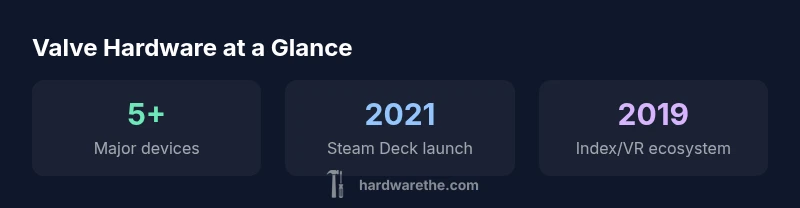
Valve Index released in 2019 as a high-end VR system featuring precise tracking and advanced controllers (Knuckles). The Knuckles controllers let you grip virtual objects with finger-level input, which pushed the VR experience beyond conventional gamepad input. Together with Lighthouse tracking, Index established a reference hardware for PC VR at the time and influenced subsequent headsets and controllers. This block highlights Valve's preference for integrated hardware and software that complements SteamVR content, and underscores how hardware decisions can shape the software ecosystem and content strategy.
Other hardware: Steam Link, Steam Controller, Steam Machines
Steam Link (2015-2018) was a streaming device enabling PC games over a local network, illustrating Valve's attempt to bridge PC gaming with living-room setups. The Steam Controller (2015) sought to unify keyboard/mouse inputs with new control paradigms; its discontinuation in 2019 taught Valve about market fit and product testing. Steam Machines (2015-2016) aimed to bring SteamOS-powered PCs to living rooms but faced competition from established consoles and PC builds; the program was discontinued as distributors shifted toward more flexible PC configurations and streaming options. The takeaway is that hardware programs must align with user behavior and retail realities to succeed.
Design philosophy and ecosystem strategy
Valve's hardware philosophy centers on tight integration with its software ecosystem, prioritizing seamless SteamOS compatibility, Rift-to-SteamVR interoperability, and robust driver support. The company tends to release hardware that tests a new interaction paradigm or strengthens the Steam platform rather than chasing short-term hardware sales alone. For builders and DIY enthusiasts, this approach translates into actionable lessons: define a clear software-integration goal, anticipate updates to the Steam Store, and design with future-proofing in mind. This section also discusses how Valve's hardware choices aim to simplify the user journey—from purchase to setup to gameplay—by maintaining consistent user experiences across devices.
Practical tips for DIY and hardware planning with Valve devices
When planning DIY projects or home setups around Valve hardware, consider these practical guidelines: choose devices that maximize ecosystem benefits (Steam Deck for portability; Index for VR), verify compatibility with your existing PC and SteamOS, and plan for software updates that may affect performance and features. If you own multiple Valve devices, map out cross-device workflows (e.g., Steam Link streaming to a Deck or PC VR sessions using Index). Finally, stay informed about Valve's hardware roadmap through trusted sources and community discussions to anticipate new releases or software updates that impact your setup.
Valve hardware lineup overview and status
| Device | Launch Year | Current Status | Notes |
|---|---|---|---|
| Steam Deck | 2021 | active | Handheld PC running SteamOS; dockable with external displays |
| Valve Index | 2019 | active | VR headset with precise tracking and Knuckles controllers |
| Steam Link | 2015–2018 | discontinued | Streaming device; functionality integrated elsewhere |
| Steam Controller | 2015 | discontinued | Alternative input device; not continued |
| Steam Machines | 2015–2016 | discontinued | Living-room PC concept; market shift ended program |
FAQ
What hardware has Valve made besides Steam software?
Valve has produced several notable hardware products, including the Steam Deck handheld PC, Valve Index VR headset and Knuckles controllers, Steam Link streaming device, Steam Controller, and the Steam Machines line. These products illustrate Valve's approach to integrating software with hardware to enhance the Steam ecosystem.
Valve has released hardware like the Steam Deck and Valve Index, plus older items like Steam Link and Steam Controller to broaden the Steam ecosystem.
Are Valve hardware devices still supported?
Active devices such as the Steam Deck and Valve Index continue to receive updates and SteamVR improvements. Discontinued devices like Steam Link, Steam Controller, and Steam Machines no longer receive official updates, but their legacy software can often be emulated or accessed via Steam.
Active devices are supported; discontinued ones are legacy.
Is SteamOS still relevant for Valve devices in 2026?
SteamOS remains a key component for Valve's hardware like the Steam Deck, enabling a Steam-centric experience. However, Valve continues to blur lines with Windows and Linux-based workflows, so expectations should be practical regarding broad software compatibility.
SteamOS stays central for Deck, but cross-platform options exist.
What happened to Valve's Steam Machines program?
Steam Machines aimed to bring SteamOS to living-room PCs but struggled due to market competition and hardware fragmentation. Valve ended the program and shifted focus to Steam Deck and PC VR via Index rather than a broad hardware platform.
Steam Machines was discontinued as the market evolved.
Will Valve release more hardware in the future?
Valve tends to reveal hardware when it aligns with Steam ecosystem goals, such as VR capabilities or portable gaming, but concrete timelines are not typically announced far in advance. Expect future hardware if it meaningfully enhances the Steam experience.
Valve hints at future hardware only when it enhances Steam.
How do Valve Index and Steam Deck compare for a DIY setup?
Index is VR-focused with high-precision tracking suited for immersive experiences, while the Deck is a handheld PC designed for portable Steam gaming. Your DIY setup should prioritize VR space and power/thermals for Index, or battery life and docking flexibility for Deck.
Index is VR-first; Deck is portable PC gaming.
“Valve’s hardware strategy prioritizes ecosystem coherence and user experience over sheer device quantity, guiding developers to design software that complements the hardware stack.”
Main Points
- Identify Valve's active hardware and plan around its ecosystem
- Expect Steam Deck and Index to remain core assets in 2026
- Note which devices were discontinued to avoid investing in aging hardware
- Check compatibility with SteamOS and SteamVR for best results