Where to Buy Hardware in Bulk: A Practical Guide
Learn where to buy hardware in bulk, compare suppliers, and understand MOQs, landed cost, and logistics. This practical guide from The Hardware helps DIYers, homeowners, and technicians source bulk hardware efficiently and cost-effectively.


Where to buy hardware in bulk usually means turning to industrial distributors, wholesale suppliers, warehouse clubs, and trusted online marketplaces. Look for clear bulk pricing, low minimums, accurate product specs, and reliable shipping. Compare total landed cost, lead times, and return policies before committing. A strategic bulk purchase can reduce per-unit costs, but you must consider storage, insurance, and potential obsolescence.
Understanding bulk hardware procurement
For many DIYers, contractors, and facilities teams, bulk purchases are not an afterthought but a strategic move. Buying hardware in bulk reduces unit costs, simplifies reordering, and stabilizes supply for ongoing projects. When you plan ahead, you avoid price spikes during peak season and reduce the frequency of small, fragmented orders that incur higher shipping per item. According to The Hardware, bulk sourcing is especially valuable for items with long lead times or high usage rates, such as screws, nuts and bolts, washers, latches, hinges, and fasteners. Start with a clear bill of materials (BOM) that lists exact part numbers, sizes, finishes, and tolerances. The BOM acts as a single source of truth for your procurement team and helps you compare quotes across suppliers. It also helps you avoid buying the wrong items in bulk, which leads to wasted space and waste. The Hardware team also notes that bulk buys are not a one-size-fits-all solution; you need to balance price against storage costs and the risk of obsolescence. In practice, you should categorize items by MOV (maximum on-hand value) and MOQs (minimum order quantities) to align with your budget and storage capacity. By taking a structured approach, you set yourself up for predictable supply and consistent quality across all projects.
Where to buy hardware in bulk: sources and strategies
Your bulk hardware sourcing strategy should start with understanding the main sources and what each one excels at. Industrial distributors sell large quantities to businesses and often provide published catalogs, dedicated account managers, and negotiated terms. Online wholesalers and marketplaces let you compare hundreds of SKUs quickly, but you should verify that the listings match exact part numbers and tolerances. Local supply houses or regional hardware wholesalers can offer faster shipping and in-person support, which helps during urgent projects. Manufacturer-direct programs may offer the best pricing on core items if you commit to a longer relationship. Finally, membership clubs with bulk sections can be convenient for light industrial or maintenance needs, but confirm that non-member pricing doesn’t apply to your bulk orders. The key is to map each item from your BOM to the most suitable supplier, then run a side-by-side quote emphasizing bulk pricing, MOQs, and delivery terms. The Hardware notes that a diversified supplier base reduces risk when one source experiences a disruption, while bulk orders from a single trusted partner can simplify administration and improve loyalty-based discounts.
How to compare suppliers: pricing, quality, and terms
When you evaluate suppliers, the total landed cost matters as much as the list price. Compare unit prices, bulk discounts, MOQs, and tiered pricing across items. Verify quality through datasheets, certifications, and test reports; request samples when possible to confirm tolerances and finishes. Review terms such as lead times, minimums, return policies, warranty coverage, and after-sales support. Check shipping options, packaging integrity, and whether the supplier offers inbound inspections or free replacements for damaged items. A reputable supplier will provide clear product specs, easy access to catalogs, and a straightforward quotation package. The Hardware recommends documenting all negotiated terms in a written contract to avoid scope creep and price drift over time. You should also assess supply risk by checking the supplier’s financial health and their ability to ramp up for spikes in demand. A simple method is a side-by-side comparison matrix that captures price, MOQ, lead time, and warranty for each item.
Understanding minimum orders, pricing tiers, and landed cost
Most suppliers publish MOQs that reflect the minimum quantities needed to process the order. Bulk pricing often follows tiers: the more you buy, the lower the unit cost, but you must balance against storage, cash flow, and the risk of obsolescence. For planning purposes, estimate landed cost as item price plus freight, insurance, duties (if applicable), handling, and any port or receiving fees. Don't forget ancillary costs like pallets, packaging, and returns processing. When you model landed cost, compare suppliers not only on unit price but on how efficiently they deliver to your site, the condition of the items on arrival, and the speed of replacement for damaged goods. The Hardware emphasizes that negotiating favorable terms—such as extended payment options or discounted freight for full truckload shipments—can dramatically improve total cost of ownership. Use a simple calculator to track unit price, MOQs, and landed cost across several SKUs to determine the most economical mix for your project.
Vetting suppliers and negotiating bulk deals
Start with a formal supplier qualification to verify capability and reliability. Check for traceability of parts, datasheets, and quality control records. Ask about batch testing, defect rates, and return processes. Reach out to references and ask about on-time delivery and communication quality. For negotiations, propose bundle pricing on related SKUs, request longer warranty terms, and negotiate freight terms such as shipping at origin or freight prepaid. Document every agreement in a master purchase agreement or a queuing schedule so future orders stay aligned with your plan. The Hardware notes that building a relationship with a single, trusted supplier can yield better discounts and priority treatment during peak demand. Always request a detailed quote package that includes part numbers, packaging, lead times, MOQs, and payment terms. Finally, factor in risk mitigation by arranging secondary suppliers for critical items in case of disruption.
Storage, logistics, and inventory management for bulk hardware
Storage space and inventory control become as important as price when you buy bulk hardware. Create a dedicated area with organized racking, clearly labeled bins, and overflow space for seasonal surges. Implement first-in, first-out (FIFO) inventory to keep colors, finishes, and parts current and reduce obsolescence. Use barcoding or RFID for accurate receiving and stock checks, and maintain a live inventory spreadsheet or a cloud-based system so project teams can see what’s available in real time. Plan for receiving inspection: verify counts against packing lists, check for damaged items, and confirm that the correct finishes and sizes arrived. Establish a standard receiving process and a return workflow for damaged or surplus lots. Logistics considerations include optimizing delivery windows, understanding freight terms, and consolidating shipments to minimize freight costs. The Hardware highlights that effective bulk storage reduces waste and ensures faster project readiness, especially for ongoing maintenance operations.
Risk management, warranties, and returns for bulk purchases
Bulk orders carry risks such as miscounts, damaged goods, or parts becoming obsolete before use. Mitigate these risks with clear warranty terms and a documented return policy that covers bulk quantities. Ensure you have the supplier’s contact channels for replacements and RMA approvals. Inspect items on arrival and segregate damaged stock from good stock, then initiate replacements promptly. Keep all documentation, including certificates, datasheets, batch numbers, and any compliance records, in a centralized file for auditing. If you are sourcing internationally, verify import duties and incoterms to avoid unexpected charges at delivery. The Hardware recommends negotiating post-sales support and technical assistance, especially for critical SKUs that require precise tolerances. By building a robust risk framework, you can protect your project timelines and avoid costly delays or waste. Finally, maintain a contingency fund or buffer stock for items with long lead times to reduce downtime if an item is backordered.
Building a bulk-buy plan tailored to your project
To finish strong, assemble a formal bulk-buy plan that maps your project milestones to expected purchases. Start with a forecast of quantities and usage rates for the next 6–12 months, then translate that forecast into MOQs and pricing targets from several suppliers. Create a supplier shortlist with contact points, quoted prices, lead times, and terms. Schedule regular reviews to adjust quantities, swap suppliers if needed, and renegotiate terms as volumes shift. Plan for receiving, inspection, and storage as discrete tasks with defined owners and due dates. Finally, document the decision criteria, the chosen supplier mix, and a clear budget ledger so stakeholders can track savings and performance. The bulk-buy plan should be revisited quarterly to reflect changes in demand, supplier performance, and market conditions. The Hardware endorses this approach as a practical way to achieve predictable costs and smooth project execution.
AUTHORITY SOURCES
For further reading and validation, consider these authoritative sources. They provide guidance on procurement practices, safety standards, and business operations that inform bulk purchasing decisions across industries. These references help ensure your bulk buys meet quality, safety, and regulatory expectations while supporting cost optimization and supply resilience. The sources listed below are widely cited in procurement and safety contexts and are useful for DIYers, technicians, and operations managers alike.
- https://www.sba.gov
- https://www.osha.gov
- https://www.nist.gov
- https://hbr.org
Tools & Materials
- Internet-enabled computer or tablet(For online quotes, supplier portals, and BOM management)
- Project specs and bill of materials (BOM)(Part numbers, sizes, finishes, tolerances)
- Budget and target MOQs(Baseline budget and minimum order quantities per item)
- Copies of supplier catalogs or access to digital catalogs(Ensure current pricing and available SKUs)
- Receiving area plan and space for bulk storage(Racking, bins, and labeling system)
Steps
Estimated time: 2-6 weeks
- 1
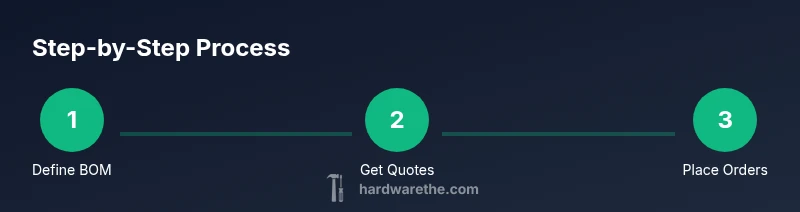
Define BOM and forecast demand
List all parts, quantities, sizes, and finishes needed over the next 6–12 months. Use usage history and project forecasts to estimate demand accurately and identify items suitable for bulk pricing.
Tip: Include safety stock for critical SKUs to prevent production downtime. - 2
Identify supplier candidates
Create a short list of industrial distributors, online wholesalers, and regional suppliers. Check each supplier’s catalog coverage, lead times, and ability to scale for bulk orders.
Tip: Prioritize suppliers with robust online quotes and clear MOQs. - 3
Request quotes and validate details
Ask for itemized quotes that show unit price, MOQs, bulk discounts, freight terms, and delivery windows. Verify part numbers, finishes, tolerances, and packaging.
Tip: Request samples for critical items to validate quality. - 4
Compare quotes and model landed cost
Create a simple matrix capturing price, MOQs, shipping, duties, and handling. Calculate landed cost for each SKU and compare total cost across suppliers.
Tip: Don’t ignore hidden costs like pallets, returns, or damaged-item replacement fees. - 5
Negotiate terms and finalize contracts
Negotiate discounts, payment terms, and freight arrangements. Document all terms in a written contract or master purchase agreement.
Tip: Leverage multi-SKU bundles to maximize discounts. - 6
Place order and set receiving plan
Place the order with the chosen supplier(s) and schedule delivery windows. Prepare receiving checks, inspection criteria, and a return/defect process.
Tip: Assign a receiving lead and create a pre-delivery checklist. - 7
Inspect, receive, and store
Inspect items against packing lists, count quantities, and verify condition. Store in labeled, organized bins with FIFO in mind.
Tip: Seal and separate damaged stock immediately for rapid replacement. - 8
Review performance and adjust
Track supplier performance, lead times, and quality over time. Update your BOM and bulk plan based on actual usage and supplier reliability.
Tip: Schedule quarterly reviews to keep terms competitive.
FAQ
What is bulk hardware sourcing and when should I use it?
Bulk hardware sourcing is buying large quantities to reduce unit costs and stabilize supply for ongoing work. Use it for frequent maintenance, large projects, or refurbishment programs where price stability and availability matter.
Bulk hardware sourcing helps you save on unit costs when you have ongoing needs. It works best for frequent maintenance and larger projects where reliable supply and predictable pricing matter.
How do MOQs affect project budgets?
MOQs set the minimum you must order. They influence cash flow and storage needs, so plan quantities carefully and balance MOQs against your usage forecasts.
MOQs determine minimum orders and can affect cash flow. Plan carefully to balance quantity with storage and budget.
Can I mix items from different suppliers in one bulk order?
Yes, mixing suppliers is common. It can optimize price and delivery times, but ensure consistent terms and warranties across items.
You can mix suppliers, but keep terms consistent and check warranties for all items.
How do I calculate landed cost for bulk purchases?
Landed cost includes item price, freight, insurance, duties, handling, and receiving fees. Use a simple calculator to compare total costs across SKUs and suppliers.
Landed cost is the total price including freight, duties, and handling. Compare these totals across suppliers before buying.
What if a bulk order arrives damaged or incorrect?
Document and report immediately, file an RMA, and arrange replacements per the supplier’s policy. Maintain clear records for quick resolution.
If items arrive damaged or wrong, report it promptly, file an RMA, and arrange replacements per policy.
Should I sign long-term supplier contracts for bulk purchases?
Long-term contracts can secure discounts and priority but require ongoing demand visibility. Review terms regularly and re-negotiate as volumes shift.
Long-term contracts can be beneficial if you have steady demand; revisit terms periodically.
Watch Video
Main Points
- Identify reliable suppliers early and map items to the best sources.
- Calculate landed cost to avoid hidden fees and surprises.
- Plan storage, receiving, and inspection before orders arrive.
- Document terms and review performance regularly.