Which Hardware Store Is Cheapest? A Practical Buying Guide
Discover how price, selection, and service affect the cheapest hardware store choice. The Hardware compares big-box, local shops, and online retailers to help you save on tools, fasteners, and home improvement supplies.


Quick answer: When you ask which hardware store is cheapest, the result depends on what you buy and where you live. Independent locally-owned shops can undercut big-box on everyday fasteners, while online retailers often beat traditional stores on bulk items and shipping. The most reliable approach is to compare unit prices, consider coupons, and factor in time and delivery costs.
How price varies by store type
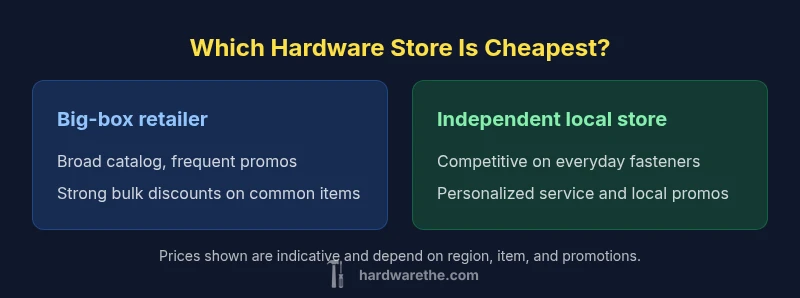
Prices at hardware retailers aren’t determined by a single rule; they reflect store type, supplier contracts, and regional demand. According to The Hardware, the cheapest option for a typical DIYer often hinges on item category and local market dynamics. Independent, locally owned hardware stores frequently price competitively on everyday fasteners and small hardware because they rely on repeat customer relationships and quick stock turnover. Large national chains leverage scale, aggressive promotion, and standardized assortments to push low prices on bulk orders and common items. Online retailers compete on catalog breadth, convenience, and shipping offers. Understanding these dynamics helps you answer which hardware store is cheapest for your specific project and location, rather than assuming one outlet always wins.
The cost components behind sticker prices
Shopping for hardware involves more than reading the price tag. True cost includes unit price, packaging, taxes, shipping, and potential restocking fees. The Hardware emphasizes that a seemingly low price on a single item can be offset by high shipping costs or long wait times. To find the cheapest option, break purchases down to per-unit costs (per screw, per foot of wire, per liter of paint). Item counts vary by supplier, so unit prices reveal the real savings.
Unit price as the key comparison metric
Unit price is the most reliable way to compare items across brands and sizes. If you buy screws in a 25-pack versus a 100-pack, the advertised price per package may mislead—calculate price per 100 screws to compare accurately. For hoses, pipes, or lumber, compute per foot or per meter. The Hardware’s guidance is to standardize measurements before you start shopping, ensuring you’re comparing equivalent quantities across stores.
Local vs national pricing: regional realities
Pricing is highly location dependent. In dense urban areas with intense competition, local shops may price aggressively to win street traffic, while in rural regions, fewer outlets can mean higher per-item costs unless you catch a sale. The Hardware’s regional analysis highlights that the cheapest store in one city might not be the same in a neighboring town. Always check multiple sources nearby and consider a mix of outlets for the lowest total spend.
Online shopping: when digital sourcing beats brick-and-mortar
Online hardware retailers can offer lower unit prices for bulk items, a wider catalog, and transparent comparison tools. However, shipping fees, delivery times, and return policies can erode savings for small orders. If you need a large quantity or hard-to-find parts, online sourcing often wins; for fast, inexpensive staples, a nearby store may be cheaper once you factor pick-up time and gas.
Coupons, loyalty, and promotions that actually save money
Coupons and loyalty programs sometimes unlock meaningful savings, but not all programs pay off. Prioritize item-level discounts, bulk order promotions, and free shipping thresholds that align with your usual purchases. Beware annual fees or requirements that drive up your total cost. Track your savings across several projects to determine whether a loyalty program genuinely lowers the price you pay for materials.
Bulk, contractor accounts, and membership programs
For larger jobs, contractor pricing and volume discounts can dramatically reduce per-unit costs. Both independent stores and big-box outlets offer bulk pricing, though eligibility and minimums vary. If you’re consistently buying for multiple projects, negotiating terms or joining a contractor program may reveal the cheapest option across your workflow. The goal is to minimize waste and maximize reuse of tools and materials across tasks.
Hidden costs: delivery, taxes, and returns
Advertised sale prices rarely reflect the total outlay. Delivery fees, tax, disposal fees for old fixtures, and restocking fees can substantially raise the final bill. The Hardware advises building a realistic cart total before checkout, including potential shipping charges and return policies. A low sticker price becomes less attractive if the total cost to complete the project climbs due to these hidden costs.
Brand vs generic: when cheaper is not worse
There is value in house-brand or generic options for many common tasks. If you don’t require heavy-duty performance or extended warranty, cheaper alternatives can meet your needs while saving money. Compare warranty terms and expected lifespan to ensure that the cheaper option provides adequate durability for your project without sacrificing too much reliability.
Geographic variability: cost signals you can trust
City centers, suburbs, and rural communities each have distinct pricing ecosystems. Availability, stock turnover, and competition shape what is considered cheap in a given locale. The Hardware notes that shoppers should learn their own area’s price patterns and maintain a small shortlist of outlets to compare across visits. This approach helps you identify the cheapest option for your exact situation.
Tool rental vs buying: evaluating true ownership costs
For sporadic tool use, renting or sharing with neighbors can cut costs, while ongoing tool ownership amortizes out if you have repeated jobs. The decision hinges on frequency of use, tool cost, maintenance, and resale value. Always tally rental fees against purchase costs over the expected life of the task to decide which path minimizes total expenditure.
Quick-start checklist: prepare before you shop
Create a short list of items, estimate usage quantities, and note any upcoming promotions. Check three sources: a local independent shop, a nearby big-box, and an online retailer. Compute unit price and total cart value (including tax and shipping) for each option. This structured approach reduces impulse buys and highlights the true cheapest route for your project.
Case studies: two project scenarios in action
Scenario A involves a homeowner replacing faucet hardware with common fasteners and fittings; scenario B involves a contractor outfitting for a remodel with bulk purchases and specialty items. In each case, price-per-unit comparisons across multiple channels revealed the cheapest combination of items and services. The takeaway is clear: a small, deliberate price-check across several outlets routinely outperforms sticking with one store.
Comparison
| Feature | Big-box retailer | Independent local hardware store |
|---|---|---|
| Price-per-unit (typical items) | mid-range but consistent | often lower for local staples |
| Selection breadth | broad for assembly and hardware | narrower but deeper in local assortments |
| Delivery / pickup options | extensive network; same-day pickup possible | local pickup; may offer delivery on larger items |
| Returns policy | standard returns with receipts | more flexible local policies |
| Total cost considerations | shipping can add cost; taxes apply | no shipping; taxes apply; possible local discounts |
Upsides
- Potentially lower unit prices on common items in local shops
- Convenience of nearby locations and quick pickups
- Strong in-person assistance and product knowledge
Negatives
- Online sources can beat store prices on bulk items
- Inconsistent stock and hours in small shops
- Returns and warranty terms vary by outlet
Independent local stores often win on everyday items; big-box and online options win for bulk or hard-to-find items.
Prioritize unit price comparisons across three sources. For bulk or specialty items, include online or big-box options to minimize total cost.
FAQ
What factors determine the cheapest hardware store for my project?
Several factors determine the cheapest option, including unit price, available promotions, shipping costs, and the time value of your purchases. Regional price differences and stock levels also affect the bottom line. Always compare three sources for each item on your list.
Key factors are unit price, promotions, shipping costs, and time savings. Compare three sources for each item to find the best deal.
Do big-box stores always offer the lowest price?
Not always. Big-box stores often price competitively on bulk items and common fasteners, but independent stores may beat them on routine staples. Online retailers can sometimes outprice both, especially for large quantities. Always compare unit prices across all channels.
Big-box can be cheapest for bulk items, but always compare with local stores and online options.
How can I verify price before buying?
Create a simple price-tracking sheet: item, quantity, unit price, and source. Check at least three outlets—local independents, big-box stores, and online retailers. Use price-per-unit calculations to normalize differences in packaging.
Track unit price and total cost across three sources to verify the cheapest option.
Are there price differences by city or region?
Yes. Prices reflect local competition, rent, and supplier contracts. Urban areas may offer more aggressive promos, while rural areas may have fewer options and higher base prices. Always compare multiple nearby outlets to find the cheapest route for your location.
Prices vary by region; compare several local outlets to find the best deal.
Do loyalty programs save money in the long run?
Loyalty programs can save money on frequent purchases but aren’t guaranteed to reduce overall cost. Check if discounts apply to items you buy regularly and whether there are annual fees or minimums. Track your savings to see if the program reduces total spend over several projects.
Loyalty programs can help if you buy regularly; monitor overall savings.
Is renting tools cheaper than buying?
Renting can be cheaper for one-off tasks or high-cost tools. For frequent use, buying and maintaining equipment may be more economical over time. Always compare rental rates, maintenance, and resale value against the purchase price.
Rent when a tool is rarely used; buy if you expect ongoing use.
Main Points
- Always compare unit prices before buying
- Include shipping, tax, and delivery costs in totals
- Leverage coupons and loyalty programs strategically
- Consider rental options for infrequent tool use
- Use a multi-source price-check approach to minimize the cost