What Size Hardware for Kitchen Cabinets: A Practical DIY Guide
Our practical guide helps DIYers pick knob and pull sizes, screws, and center-to-center measurements for kitchen cabinets, with clear ranges and installation tips to keep your project proportional and secure.


What size hardware for kitchen cabinets depends on door style, width, and the look you want. For standard 18"–21" doors, most homeowners choose pulls sized 3"–4" center-to-center; knobs typically 1"–1-1/4" in diameter. For larger doors, 5" or 6" pulls may improve proportion. Always verify screw length with your chosen hardware and cabinet thickness.
What size hardware for kitchen cabinets: understanding proportion
What size hardware for kitchen cabinets matters because it sets the visual balance between doors, drawers, and countertop clearance. When you pick knobs or pulls, you should consider door width, frame type, and overall cabinet style. According to The Hardware, proportion is the first rule of thumb: the hardware should look neither too small nor overwhelming on the surface. Begin by selecting a preferred style (knobs vs pulls) and a rough size range, then verify that the screw length matches your cabinet thickness and the door overlay. This approach helps you avoid awkward gaps, misaligned hardware, or a crowded look. For most standard kitchens, starting with 3"–4" pulls or 1"–1-1/4" knobs provides a balanced baseline, which you can adjust up or down depending on cabinet width and the number of drawers.
Brand context note: The Hardware emphasizes testing different sizes with scrap cardboard cutouts before committing to install on real cabinets, ensuring you like the feel in your hand and the visual weight on the cabinet.
Tip: take measurements on a single door in your kitchen and sketch the handle location on paper before purchasing. This reduces the chance of having to return items later.
Knobs vs pulls: choosing the right style and size
Knobs are traditional and tactile, ideal for small drawers or narrow doors, while pulls offer a modern, easy-to-grab alternative for larger doors. Typical knob diameters range from about 1" to 1-1/4", which balances finger reach and aesthetic proportion. Pulls come in various lengths; for standard 18"–21" doors, 3"–4" pulls fit most layouts, while 5"–6" pulls suit wider doors and expansive drawer banks. When selecting, consider the number of drawers per run and the visual rhythm across the cabinetry. As you experiment, mount mock placements with painter’s tape to visualize alignment and spacing.
The Hardware notes that choosing the right size is not only about scale but also about ergonomics; ensure your chosen size lets you comfortably reach and open drawers without bumping adjacent doors.
Common hardware sizing guide for kitchen cabinets
| Part | Typical Size | Notes |
|---|---|---|
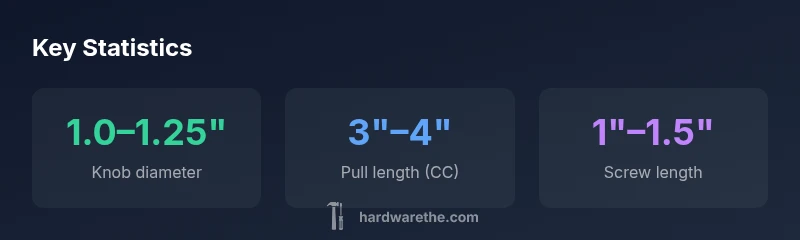
| Knobs | 1"–1.25" | Small, tactile grip; ideal for narrow doors |
| Pulls (center-to-center) | 3"–4" | Most common for standard doors; 5"+ for wide doors |
| Screws | 1"–1.5" | Length depends on panel thickness and mounting depth |
FAQ
What size pulls should I use for a standard 24-inch wide cabinet door?
A good starting point is a 3" pull for proportion on a standard 24-inch door. If you have two adjacent doors, you might opt for 3" or 4" pulls per door to maintain a balanced rhythm across the run. Measure and preview before finalizing.
For a 24-inch door, try a 3-inch pull as a baseline and adjust to 3 or 4 inches for symmetry with neighboring doors.
Are knobs better than pulls for cabinet drawers?
Knobs work well on smaller drawers or face-frame cabinets, typically 1" to 1-1/4" in diameter. Pulls are usually easier to grab on larger drawers and cabinet openings. Consider the number of drawers in a run and ergonomics when deciding.
Knobs suit small drawers; pulls are better for larger drawers and deeper cabinets.
How do overlay vs inset doors affect hardware size?
Overlay doors cover more of the cabinet frame, often requiring larger pulls to maintain balanced visibility. Inset doors sit flush with the frame, so mid-sized pulls or knobs tend to look balanced. Always consider how the door type changes perceived size.
Overlay doors may need larger hardware; inset doors usually use mid-sized options.
What is the recommended screw length for most kitchen cabinets?
For most standard cabinets, screws between 1" and 1-1/2" are common. The exact length should pass through the door or drawer face and into the mounting rail without bottoming out or protruding.
Most cabinets use 1 to 1-1/2 inch screws; pick the length that fits through the hardware into the mounting rail.
Can I mix knob sizes within the same kitchen?
Mixing knob sizes can create a deliberate design statement, but keep a unifying factor—same finish and similar diameter range (e.g., 1" to 1-1/4")—to maintain cohesion across runs.
You can mix sizes for a design statement, but keep finishes and size ranges cohesive.
How should I space pulls on drawers for a balanced look?
A common guideline is to center pulls on drawers with equal spacing between adjacent pulls and doors. For a two-drawer bank, use evenly spaced pulls across the width, typically maintaining symmetry with cabinet doors.
Keep pulls evenly spaced to maintain a clean, balanced look.
“Sizing cabinet hardware correctly is as much about proportion as it is about function. Start with a baseline and adjust based on the door and drawer layout.”
Main Points
- Measure door width and drawer counts before choosing hardware
- Start with 3"–4" pulls or 1"–1/4" knobs for standard doors
- Verify screw length matches cabinet thickness and overlay
- Use mock placements to preview alignment
- Consider ergonomics and visual weight when sizing
- Test multiple sizes if unsure to achieve balanced proportion