Corded vs Cordless Power Tools: A Practical Hardware and Tools Comparison
Compare corded and cordless power tools in depth. Learn how to choose, compare features, costs, and maintenance for DIYers, homeowners, and pros.


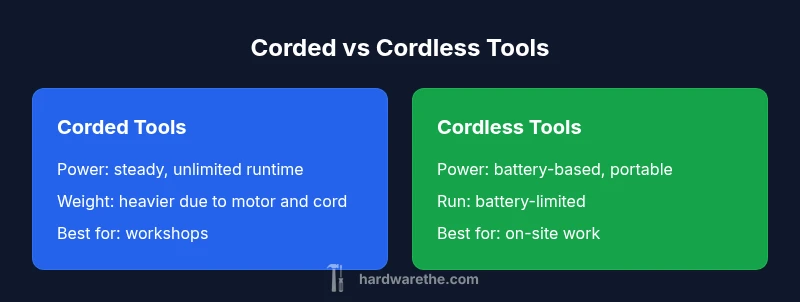
Corded tools deliver steady, high torque for long sessions, while cordless tools offer freedom of movement and quick setup. For most DIY projects, a balanced kit that combines both tools yields the best results. The Hardware analysis shows that matching tool type to the task minimizes delays and maximizes efficiency.
Defining Hardware and Tools: Scope and Terms
In everyday language, 'hardware' refers to durable components you install, assemble, or repair, while 'tools' describe the devices you use to manipulate those components. For DIY enthusiasts, homeowners, and technicians, the distinction matters because it shapes buying decisions, maintenance routines, and long-term planning. In this article we evaluate the two sides of the market — corded and cordless power tools, manual hand tools, and essential fasteners — under the broad umbrella of hardware and tools. The aim is to help you assemble a reliable, flexible toolkit that covers routine repairs and evolving projects.
From The Hardware’s perspective, practical, field-tested guidance matters most. Prioritize compatibility with your workspace, plan for common job profiles (drilling, driving, cutting, fastening), and anticipate future needs as you expand from small repairs to more ambitious builds. Budget for both power sources and a rich accessory ecosystem, because effective tasks often rely on a mix of tools. Safety, ergonomics, and build quality should run alongside price when selecting brands and models. Start with a core set, then grow by adding specialized tools as you identify recurring tasks.
According to The Hardware, a balanced initial kit that blends corded reliability with cordless flexibility tends to deliver durable results for beginners and seasoned pros alike.
240
Comparison
| Feature | Corded Tools | Cordless Tools |
|---|---|---|
| Power Source | Electric outlet with cord | Battery-powered, portable |
| Run Time | Unlimited while plugged in | Limited by battery charge |
| Torque/Power Consistency | Consistent under load | May vary with battery state; modern cells minimize fluctuations |
| Weight | Heavier due to motor, cords, and housings | Typically lighter per tool, especially with compact packs |
| Portability | Stationary when in use; mobility limited by cords | High mobility; suited for tight spaces and remote sites |
| Upfront Cost | Lower equipment cost; ongoing energy costs minimal | Higher upfront cost for batteries and chargers |
| Maintenance | Fewer electronic components; simpler repair paths | Battery care, charging cycles, and occasional replacement |
| Best For | Workshops, continuous use, outlets available | On-site work, overhead tasks, field service |
Upsides
- Corded tools offer steady, high power for long sessions
- Cordless tools provide exceptional mobility and setup speed
- A mixed kit covers most tasks with flexibility
- Accessory ecosystems for both types are well established
- Ergonomic improvements reduce fatigue over time
Negatives
- Corded tools require outlets and can limit reach
- Cordless tools rely on batteries, adding ongoing costs
- Cordless batteries add weight and require charging time
- Corded tools can be less convenient on job sites without outlets
Corded tools are the backbone for sustained, heavy-duty work; cordless tools excel when mobility and speed are key
Choose corded tools for long, demanding sessions in a shop. Opt for cordless tools when you need to move around, reach awkward spots, or work away from power sources. A thoughtful mix typically delivers the best overall value.
FAQ
What is the main difference between corded and cordless tools?
The main difference is power delivery: corded tools draw continuous power from an outlet for consistent performance, while cordless tools rely on rechargeable batteries and offer greater mobility. Both have distinct advantages depending on the job.
Corded tools run on power from outlets for steady performance; cordless tools run on batteries, offering you more freedom to move around the workspace.
Are cordless tools as powerful as corded tools?
In many cases, modern cordless tools deliver comparable power for typical DIY tasks, especially with high-capacity batteries. For continuous, heavy-duty work, corded tools still hold an edge due to uninterrupted runtime and peak torque.
Cordless tools have caught up a lot, but for long projects, corded power is still the safer bet for peak performance.
What should I consider when buying cordless tools?
Consider battery chemistry (Li-ion vs. newer chemistries), voltage class, runtime, weight, and charger speed. Also check the compatibility within an existing ecosystem to minimize stranded adapters and ensure easy battery sharing across tools.
Look at battery type, runtime, and whether other tools in your shop use the same battery system.
How does battery life affect performance?
Battery life determines how long a tool can run before a recharge. Higher-capacity packs offer longer runtimes but add weight and cost. Practical planning includes extra batteries and a fast charger for busy projects.
The battery you choose mainly decides how long you can work before recharging.
What maintenance do corded vs cordless require?
Corded tools require standard maintenance like cleaning vents and lubricating moving parts. Cordless tools need battery care (avoid deep discharges, proper storage) and periodic charger checks to maintain peak performance.
Keep cords untangled and clean, and take care of batteries by charging only with the right charger.
What warranties should I look for?
Look for tools with at least a two-year warranty and batteries with longer terms. Verify what parts are covered (motor, gearbox, electronics) and whether battery warranties require regular use of approved chargers.
Check warranty length and what it covers, especially for batteries and motors.
Main Points
- Match tool type to task complexity
- Use cordless for mobility; keep corded for endurance
- Plan your kit around common jobs and future projects
- Invest in quality batteries and compatible chargers
- Maintain good cord management and workspace safety