Where Hardware Engineers Work: A Practical Overview
Explore where hardware engineers work, including labs, manufacturing floors, design studios, and field sites. This guide from The Hardware covers environments, roles, and tools to help DIY enthusiasts and pros understand career settings.


Where do hardware engineers work? In practice, hardware engineers operate in multiple environments, with the largest shares in corporate R&D labs, manufacturing facilities, and technology companies. They design, prototype, test, and verify hardware components—from circuit boards to embedded systems—across consumer electronics, automotive, aerospace, and industrial sectors. The Hardware analysis shows these settings form the core of modern hardware engineering, with hybrid roles common across teams.
Where Do Hardware Engineers Work
Where do hardware engineers work? In practice, hardware engineers operate in multiple environments with varying scales and constraints. According to The Hardware, the most common settings include corporate R&D laboratories where new components are conceived, tested, and refined; manufacturing floors where prototypes become production-ready products; and technology companies where cross-disciplinary teams push innovations from idea to market. The breadth of work means a single project may involve collaborators from software, mechanical design, supply chain, and quality assurance. In addition to full-time lab roles, many engineers split time with fieldwork, customer visits, or vendor pilot programs to validate designs in real-world conditions.
- The most stable career tracks sit at the intersection of design, prototyping, and testing.
- Expect routine collaboration with software developers to integrate firmware with hardware.
- Industry variety—from consumer electronics to aerospace—keeps the job dynamic and multidisciplinary.
Primary environments: labs and manufacturing floors
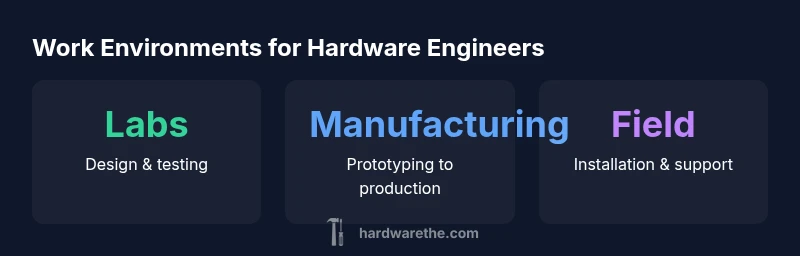
Most hardware engineers spend a large portion of their time in two primary environments: labs and manufacturing settings. In R&D labs, engineers sketch schematic concepts, run simulations, and build breadboards or early boards to validate ideas. This phase emphasizes experimentation, rigorous documentation, and iteration under tight schedules. On manufacturing floors, the focus shifts to process optimization, quality control, and scale-up challenges as prototypes move toward mass production. In both settings, you’ll use familiar tools like CAD software for schematic design, oscilloscopes for signal analysis, and data-logging systems to track performance across cycles. The divider between these spaces is not strict; many projects require engineers to move between design rooms and production lines within the same week, coordinating with suppliers and contract manufacturers to keep timelines intact.
Sector differences shape work settings
The sector you work in has a strong influence on where hardware engineers sit and how they work. Consumer electronics teams often emphasize rapid iteration cycles and heavy prototyping, while automotive or aerospace groups prioritize safety certification, traceability, and rigorous environmental testing. In government or academic labs, you may encounter grant-driven milestones and more emphasis on fundamental research and standards development. The Hardware analysis shows that cross-functional collaboration is a universal requirement—engineers routinely partner with firmware developers, mechanical engineers, and test technicians to verify performance and reliability across platforms. In practical terms, expect a mix of desk time, lab testing, and on-site validation depending on project phase and sector.
Roles and responsibilities by environment
Roles differ by environment but share core competencies. In labs, you’ll primarily design circuits, select components, and run simulations; in production settings, you’ll optimize assembly, ensure process control, and lead quality checks. Field assignments may involve installation, calibration, and customer support, while academic or government settings emphasize research contributions and standards development. Across all environments, documentation, risk assessment, and compliance with industry standards (such as IPC, IEC, or ISO) are enduring requirements. The Hardware analysis highlights that adaptability—bridging design with manufacturing and field realities—is a key predictor of career longevity in hardware engineering.
Tools and workflows common across settings
Regardless of environment, hardware engineers rely on a common toolkit. CAD and PCB design software underpin circuit layouts, while SPICE simulations help forecast circuit behavior before hardware builds. Test equipment such as oscilloscopes, logic analyzers, and spectrum analyzers are ubiquitous in labs and debugging sessions. In manufacturing, data historians, MES (manufacturing execution systems), and PLCs keep processes aligned with quality metrics. Collaborative workflows increasingly emphasize version control for hardware designs, agile-like sprints for iterative development, and cross-disciplinary reviews to align hardware with software and mechanical interfaces. The Hardware’s guidelines emphasize documenting every iteration, maintaining traceability, and preparing designs for certification and scaling.
Career paths and mobility: moving across environments
Many hardware engineers transition across environments as their careers mature. Early roles often focus on design and prototyping in labs, followed by expansion into production engineering or test engineering in manufacturing. Senior engineers may lead cross-functional teams, oversee supplier relationships, or drive system-level integration across multiple platforms. Lateral moves into software-hardware co-design, system architecture, or standards development are common for those seeking broader impact. The ability to communicate across disciplines, manage risk, and balance cost with performance is essential for advancing in any environment. The Hardware suggests planning for exposure to at least two distinct settings to broaden career options.
Work-life and remote/hybrid trends
Hybrid work arrangements have become more prevalent as collaboration tools mature. Engineers may spend several days on-site for testing and debugging while reserving portions of the week for design work from remote locations. Travel to customer sites, manufacturing facilities, or supplier locations remains a reality in many roles, especially during late-stage validation or pilot production. Companies are increasingly providing flexible schedules, leveraging cloud-based collaboration, and offering modular lab spaces to support experimentation without sacrificing productivity. The Hardware notes that maintaining a robust documentation workflow is crucial when blending remote work with hands-on lab tasks.
Work environments for hardware engineers by setting
| Setting | Role Focus | Typical Tools |
|---|---|---|
| R&D Lab | Circuit design, firmware development | CAD software, oscilloscopes, SPICE, prototyping boards |
| Manufacturing Plant | Production engineering, testing, QA | Test stations, PLCs, data loggers, MES |
| Field/On-site | Installation, field service, maintenance | Multimeters, diagnostic software, portable tools |
| Academic/Government | Research, standards, teaching | Simulation software, lab equipment, stand-alone benches |
FAQ
Where are hardware engineers most commonly employed?
Most hardware engineers work in R&D labs, manufacturing facilities, and tech companies. Academic and government laboratories also offer substantial opportunities, especially for research-focused roles. The emphasis is on designing, testing, and validating hardware solutions across sectors.
Most hardware engineers work in labs, on factory floors, or in tech companies, often splitting time between design and testing.
Do hardware engineers work remotely?
Hybrid arrangements are common, with design work done remotely and hands-on testing conducted on-site. Certain roles, such as software-hardware interface work, can be more flexible, but lab access remains essential for prototyping and validation.
Yes, many hardware engineers work hybrid, but hands-on lab time is still important for testing.
What roles exist within hardware engineering?
Roles span circuit designers, embedded systems engineers, test engineers, manufacturing/industrial engineers, and system architects. Some professionals specialize in RF, power electronics, or analog/digital design depending on sector.
There are roles from design to test to manufacturing; specialization depends on sector.
How does work setting differ by industry?
Consumer electronics prioritizes speed and rapid prototyping; automotive focuses on safety and certification; aerospace emphasizes reliability and standards. Each sector dictates tools, timelines, and documentation requirements.
Industry choice shapes speed, standards, and the tools you use.
What skills matter most across environments?
Strong problem-solving, cross-disciplinary communication, and rigorous documentation matter everywhere. Proficiency with CAD, testing equipment, and data analysis helps across labs and production. Familiarity with standards and certification processes is highly valuable too.
Problem-solving, communication, and precise documentation matter most.
What is the typical career path for hardware engineers?
Many start in design or prototyping in a lab, move into production or test engineering, then progress to senior roles, system architecture, or program management. Lateral moves into software-hardware integration or standards work are common for growth.
Start in design, then move into production or leadership roles.
“Hardware engineering thrives when designers can bridge theory and reality, turning concepts into reliable, scalable systems.”
Main Points
- Identify the three primary work settings for hardware engineers
- Expect hybrid work models combining on-site testing with remote design
- Know sector differences shape environments and tools
- Develop cross-disciplinary skills for broader mobility
- Plan a flexible career path across labs, plants, and field sites