Hardware to Keep Door Open: A Practical DIY Guide
Learn how to choose and install hardware to keep doors open, from wedges to magnetic holders. Get practical setup tips, safety guidance, and cost ranges for DIYers and pros.


With purpose-built hardware, you can reliably hold a door open using wedges, spring-loaded stops, magnets, or hold-open closers. Start by assessing your door weight, floor surface, and how long you want the door to stay open. Choose the safest option and install per manufacturer instructions. This quick guide points you to the best solutions and setup steps. Expect a simple, cost-effective solution for most interior doors.
Why hardware to keep a door open matters
Keeping a door open is more than convenience—it's practical for airflow, safety, and movement in homes and workplaces. A held-open door reduces pressure differences between spaces, supports pets and kids moving through doorways, and eases the passage of carts or packages. Proper hardware also protects hinges from repeated slamming, which over time can cause alignment issues. When selecting hardware, the main questions are: How often will the door be held, on what floor is the device sitting, and how heavy is the door? According to The Hardware, starting with a clear use-case helps you pick the simplest solution that meets your needs. For many interiors, a simple door wedge or a magnetic holder is enough; for higher-traffic doors or commercial spaces, a hold-open closer or floor-mounted mount may be warranted. The goal is a safe, stable hold that remains effective under draft, foot traffic, and occasional bumps.
Common types of hardware to keep a door open
Wedges: inexpensive and portable, they sit on the floor at the door edge and resist closing. Pros: quick to deploy, no mounting required. Cons: can slip on carpet or wet floors.
Spring-loaded stops: mount on the baseboard or hinge side; they snap back when the door closes and can be paused to hold. Pros: simple, no floor contact; Cons: can wear over time.
Magnetic door holders: a small magnet on the door and a floor or wall magnet hold the door in place; they work well on smooth floors and require little space. Pros: low-profile; Cons: require metal strike surfaces and proper alignment.
Hold-open closers: larger units installed on commercial doors that can hold a door at a set angle; good for frequent use but more costly and install-intensive. Pros: durable and adjustable; Cons: heavier installation and higher cost.
Other options include floor-mounted outriggers and door rails for high-traffic areas. When choosing, consider floor type, door weight, and how long you want the door to stay open. If you want a temporary hold, wedges or spring stops are ideal; for long-term holds, magnets or closers may be better. Each type balances ease of installation, durability, and price.
Matching hardware to door types and spaces
Door material and construction influence which hardware works best. Hollow-core interior doors with wood or composite frames are compatible with most wedges and magnets, but you must avoid floating the door on a stand-alone wedge that could slip. Solid wood doors support heavier hold-open devices, including adjustable closers, but you should still protect floor surfaces with felt pads. If the floor is carpeted, a wedge might slip; a magnetic hold-open with a floor magnet can help, but ensure the magnet is strong enough to hold against draft. For tile or wood floors, choose a non-slip wedge or a floor-mounted hold-open that won’t scuff the surface. In environments with high traffic, look for metal or reinforced plastic devices rated for frequent use; for residential use, lightweight options are typically sufficient. Accessibility: for ADA-compliant holds, select devices designed for public buildings, ensuring that the door remains easy to push open in emergencies.
How to install a simple wedge (overview)
Installing a simple wedge is one of the fastest ways to keep a door open. Start by choosing a wedge that fits the door thickness and floor type. Place the wedge flat against the door edge so that the top surface makes contact with the door and the bottom surface sits firmly on the floor. Test the door by opening to several angles and verifying it stays in place. If the door moves or slides, reposition the wedge or switch to a heavier wedge. For best results, avoid placing the wedge near carpeting seams where it can become unstable. Remember to remove the wedge if you need to close the door completely, to avoid tripping hazards.
Advanced options: magnets, hold-open closers, and safety factors
Magnetic door holders attach magnets to the door and floor or wall magnets to hold the door, a popular choice for classrooms and offices where a discreet look matters. Hold-open closers provide a controlled hold and are common in commercial settings or high-traffic entrances. When using any device, ensure it does not interfere with a door’s ability to close fully in the event of a fire, and verify that it remains clear of foot traffic paths. For homes with kids or pets, select devices with rounded edges and avoid protruding hardware that could snag clothing. Safety is a priority; never rely on a single device for egress protection if the door is part of a fire-rated assembly. Regularly inspect and replace worn components.
Maintenance, inspection, and cost guidance
Maintenance is simple but essential. Check wedges for wear or cracks and replace if the rubber surface is worn. For magnet systems, test the hold strength and inspect mounting hardware for looseness; tighten or replace as needed. If you rely on a closer, inspect the arm and seals for wear. The hardware you choose should align with your budget: wedges can be very affordable (roughly $5–$30), spring stops mid-range, and magnets or high-end closers can cost more (roughly $15–$60 and up, depending on features). The Hardware analysis shows that even modest investments can extend door lifespan by reducing misalignment and mis-slam. Also consider safety: ensure the device does not create a trip hazard and that it does not hinder egress in case of fire. For homes with kids or pets, install devices that are easy to disengage and leave no sharp edges.
Quick-start scenarios and budgeting
Scenario 1: A busy kitchen with a smooth tile floor benefits from a wedge or a magnetic holder for easy repositioning. Scenario 2: A workshop with frequent door use performs best with a sturdy hold-open closer or a floor-mounted device. Scenario 3: An apartment hallway with carpet can use a wedge that’s designed for carpet or a magnetic system. Scenario 4: A storefront or shared office should consider ADA-compliant options and high-visibility hardware. Budget ranges: wedges $5–$30, spring stops $10–$40, magnets $15–$60, and higher-end closers $60–$200+ depending on load rating and finish. By planning around traffic patterns and floor types, you can select a solution that balances convenience and safety.
Tools & Materials
- Door wedge (rubber or foam)(Non-slip base, fits door thickness.)
- Spring-loaded door stop(Mounts on baseboard or hinge side; ensure compatibility with door weight.)
- Magnetic door holder(Requires floor or wall magnet and metal strike surface.)
- Door closer with hold-open function(Ideal for high-traffic or public spaces.)
- Adhesive or mounting hardware(Use appropriate screws/anchors for floor or baseboard.)
- Measuring tape(For spacing and clearance checks.)
- Pencil and notepad(Mark alignment during planning.)
- Level(Optional to ensure flat mounting.)
Steps
Estimated time: 15-25 minutes
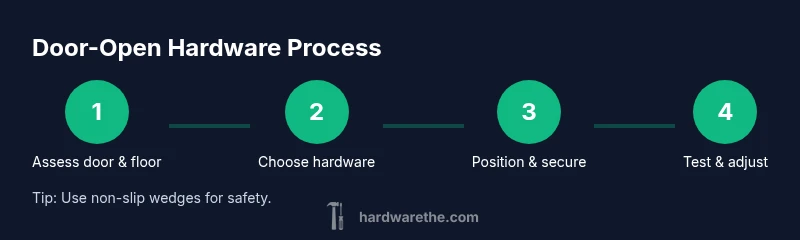
- 1
Assess the doorway and floor
Measure door thickness and floor type; confirm clearance for the chosen device and any mounting requirements.
Tip: Gather all tools before starting and read device instructions carefully. - 2
Choose the appropriate hardware
Select wedges for quick, temporary holds or magnets/closers for longer-term holds, based on traffic and floor finish.
Tip: If in doubt, start with a wedge for simplicity. - 3
Position the device
Place the wedge or install the mount according to the product’s recommended location to maximize contact with door and floor.
Tip: Test several opening angles to ensure stability. - 4
Secure the device
Attach any mounting hardware securely; ensure no loose screws or exposed edges that could catch clothing.
Tip: Use a level to align if mounting on a baseboard or frame. - 5
Test and adjust
Open the door to multiple angles; confirm it holds firmly and returns to closed position smoothly when desired.
Tip: Document adjustments for future reference.
FAQ
What is the best hardware to keep doors open for everyday use?
For most interiors, wedges or magnetic holders offer a simple, effective solution. In high-traffic areas, a hold-open closer provides more reliability and control.
Wedges or magnets work well daily; closers add reliability in busy spaces.
Are there safety concerns when using door-open hardware?
Yes. Ensure the device does not create a trip hazard or impede escape routes, especially on fire doors. Use products rated for the door’s weight and traffic.
Yes—watch out for trips and fire safety, and choose rated devices.
Can I install hold-open devices on any door?
Most interior doors can accept wedges or magnets. Exterior doors and weathered thresholds may require models rated for exterior use or specialized installation.
Most interior doors are fine; exterior doors may need sturdier options.
How do I maintain door-open hardware?
Inspect regularly for wear, clean debris, and replace worn components. Tighten loose screws and test hold strength periodically.
Check wear, clean, tighten loose parts, and test strength over time.
What are typical costs for door-open hardware?
Wedges are usually affordable, magnets and closers vary by quality and features, with typical ranges from economical to mid-range.
Costs vary; wedges are cheaper, magnets and closers can be pricier depending on strength.
Do hold-open devices affect fire doors?
Only use devices rated for fire doors and compliant with local codes to ensure safe egress. Unrated hardware can compromise safety.
Only use fire-rated devices; unapproved hardware can be unsafe.
Watch Video
Main Points
- Choose the right door-open hardware for your space.
- Test clearances to prevent trips or door damage.
- Regularly inspect and replace worn parts.
- Balance convenience with safety for reliable operation.