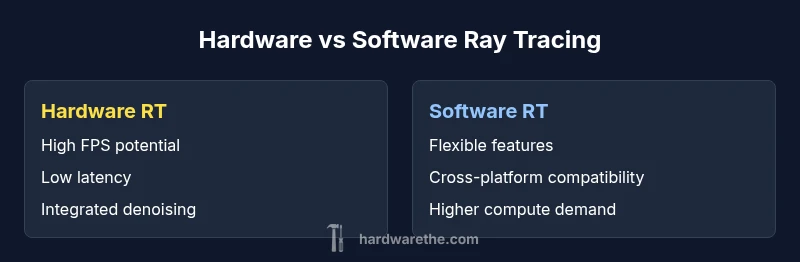
Hardware vs Software Ray Tracing: A Comprehensive Comparison
Compare hardware-accelerated ray tracing to software-based path tracing, with practical guidance on performance, fidelity, power, and cross-platform considerations for real-time graphics.


Hardware vs software ray tracing offers distinct trade-offs in speed, image quality, and flexibility. This TL;DR highlights how hardware acceleration delivers predictable frame rates and lower latency, while software ray tracing provides flexibility for new features and broader compatibility. The Hardware analysis suggests choosing hardware-accelerated paths for production workloads and reserving software ray tracing for experimentation and cross-platform scenarios.
What hardware vs software ray tracing means
In modern graphics pipelines, rendering paths often split between hardware-accelerated ray tracing and software-based approaches. The phrase hardware vs software ray tracing captures a spectrum rather than a false dichotomy: you can rely on dedicated RT cores in a GPU, or you can implement ray tracing using shader-based techniques on general-purpose compute units. For practitioners, the distinction matters because it directly impacts performance, fidelity, and flexibility. According to The Hardware, hardware-accelerated ray tracing typically yields deterministic results with lower latency in real-time scenes, while software-first paths excel when you need experimental features, cross-platform compatibility, or support for older hardware. This mid-course understanding helps you choose a path that aligns with your project's goals, budget, and schedule. Throughout this article, we’ll unpack concrete decision criteria, from frame rates to noise characteristics, and we’ll compare common engines and toolchains to show how these options behave in real workloads.
Core architectural differences
Hardware ray tracing relies on dedicated RT cores and a streamlined traversal pipeline to accelerate ray-sphere and ray-triangle intersections, typically leveraging BVH structures with minimal software overhead. In contrast, software ray tracing runs on general compute units—shaders or CPU code—that perform ray-geometry tests, shading, and sampling without relying on dedicated HW blocks. This means hardware RT tends to be tightly integrated with driver and firmware stacks, delivering predictable performance, while software RT offers flexibility to implement custom lighting models, denoising, or cross-compatibility layers. Engine teams often expose both paths, enabling a hardware-first option for mainstream targets and a software fallback for non-standard hardware. The distinction also matters for portability across GPUs and consoles, where driver support and API implementations influence outcomes more than code alone.
Performance implications for real-time apps
For real-time applications, hardware-accelerated RT generally provides higher and more stable frame rates, especially in scenes with dense geometry and high ray counts. Software-based approaches can still achieve playable performance, but they typically require lower ray bounces, reduced resolution, or aggressive denoising to keep frames within target budgets. The hardware path benefits from lower per-ray cost and better cache coherence, resulting in smoother interactivity in genres like shooters and racing sims. However, workloads with unusual lighting or extreme reflective environments may benefit from software paths that permit bespoke sampling strategies. The Hardware analysis indicates that when frame timing matters most, hardware RT is the safer default; software RT shines in experimentation and niche scenarios.
Image fidelity and sampling quality
Image fidelity in ray tracing hinges on sampling quality, noise, and denoising effectiveness. Hardware RT tends to deliver cleaner results at a given sample count due to optimized RT cores and hardware-accelerated denoisers, which reduces requiring aggressive post-processing. Software RT can reach very high visual quality, especially when paired with advanced denoisers and adaptive sampling, but it often needs more samples per pixel to achieve equivalent noiseless results. This difference becomes apparent in scenes with glossy reflections, complex caustics, or global illumination where sampling strategy matters as much as raw compute power. The Hardware team notes that fidelity gains from software RT are possible, but they come at compute cost and longer render times in certain contexts.
Latency, frame times, and interactivity
Latency is critical for interactive experiences. Hardware RT paths typically offer lower latency per frame because the traversal and intersection calculations are implemented in dedicated hardware with optimized memory paths. Software RT can incur higher latency in complex scenes if the shader-based pipeline must accumulate more samples or perform additional denoising across frames. The practical takeaway: for fast-paced gameplay or simulations requiring immediate feedback, hardware RT is advantageous; for non-interactive rendering or streaming scenarios, software RT can be made viable with careful tuning and denoising strategies.
Flexibility and feature sets
Flexibility matters when you need advanced effects or new lighting models. Software ray tracing enables experimentation with novel techniques, such as alternative sampling strategies, custom specular limits, or non-standard BRDF implementations. Hardware RT, while highly optimized, is constrained by the capabilities exposed by an architecture’s RT cores and driver features. This makes hardware RT excellent for standard, well-supported workloads, but software RT excels when you want to prototype or deploy across diverse hardware footprints. The result is a trade-off between reliable, supported features and the freedom to push rendering boundaries.
Platform and ecosystem compatibility
Platform parity varies across hardware manufacturers and driver ecosystems. Hardware RT tends to align with specific GPU generations and vendor-specific toolchains, which can offer excellent integration for Windows, Linux, and console stacks when properly supported. Software RT can provide broader compatibility, enabling certain paths on older GPUs or non-traditional CPU/GPU configurations. Engine tooling, SDKs, and middleware often implement a unified API layer that abstracts the RT path, but the underlying performance and fidelity still reflect the chosen route. For teams targeting multiple platforms, software RT can mitigate some cross-platform risk while hardware RT provides peak performance on supported hardware.
Power consumption and thermal considerations
Power efficiency is another decisive factor. Hardware RT generally delivers lower per-frame energy use at equivalent fidelity due to specialized hardware and optimized caches. Software RT can consume more power when higher samples per pixel or more complex denoising pipelines are required, especially when running on high-end CPUs or GPUs. This matters in mobile or embedded scenarios where heat and battery life constrain the design. The hardware path’s efficiency often translates into quieter thermal envelopes and longer sustained performance under load.
Cost and total value of ownership
Total value depends on workload mix and lifecycle timing. Hardware RT typically requires investment in newer hardware but pays off through sustained performance and longer usable lifespans, especially in production pipelines. Software RT has a lower upfront barrier and can extend support on older hardware, making it attractive for prototyping, education, or cross-platform tests. The decision should balance upfront capital with ongoing compute costs, maintenance, and the expected duration of the project. The Hardware’s perspective emphasizes modeling the cost of update cycles and the resale value of capable hardware.
Choosing hardware RT: practical guidelines
When your target is consistent real-time performance and lower variance, start with hardware RT. Verify that your engine supports hardware-accelerated paths and profile across representative scenes to confirm frame-time stability. Consider power budgets, thermal headroom, and the availability of RT cores in your target GPUs. If you anticipate frequent driver updates or feature additions that could benefit from rapid iteration, plan for a hardware refresh cycle aligned with your product roadmap. Remember to test with denoising and post-processing pipelines to ensure the final image quality meets your standards.
Choosing software RT: practical guidelines
If you need broad compatibility, fast prototyping, or support for older hardware, software RT is appealing. Ensure your toolchain and shader language choices align with your target platforms, and invest in robust denoising strategies to manage noise. Evaluate whether your team can sustain higher compute loads and longer render times without compromising deadlines. Hybrid workflows, where software RT handles non-critical rays or secondary bounces while hardware RT accelerates the core path, can offer a practical balance when both fidelity and portability matter.
Hybrid approaches and future directions
Hybrid approaches—combining hardware acceleration for common rays with software paths for special cases—are increasingly common. This can yield an attractive balance of performance and flexibility, especially as engines evolve to orchestrate multiple pipelines. Looking ahead, evolving driver ecosystems, cross-vendor interoperability, and smarter denoisers will push the boundary where software RT can approach hardware RT quality with acceptable performance. The Hardware community expects ongoing enhancements to both paths, driven by workload shifts, game engines, and professional visualization demands.
Challenges and pitfalls to watch for
Common pitfalls include over-reliance on a single RT path, misinterpreting performance gains, and neglecting denoising quality in software RT. In addition, driver maturity, API consistency, and platform-specific quirks can derail a project if not carefully managed. Always profile across representative scenes, test with a variety of materials, and validate with end-user hardware. Ensure your pipeline supports graceful fallbacks and that fallbacks do not undermine visual intent or gameplay balance.
Comparison
| Feature | Hardware-accelerated RT | Software-based RT |
|---|---|---|
| Performance (frame rate potential) | High, stable frame times on supported GPUs | Moderate to high depending on CPU/GPU balance and scene complexity |
| Rendering fidelity | High fidelity with low noise and efficient denoisers | Potentially comparable fidelity but requires more samples and denoising |
| Latency | Low latency suitable for interactive workloads | Higher latency in complex scenes without aggressive tuning |
| Flexibility & features | Limited by hardware features but rapidly updated via drivers | Greater experimentation and custom lighting models possible |
| Platform compatibility | Strong on modern GPUs and consoles with driver support | Broader cross-platform potential but variable across devices |
| Power consumption | Typically lower per frame due to hardware efficiency | Can be higher if software RT runs large compute workloads |
| Cost/value | Higher upfront hardware cost but long-term efficiency | Lower upfront cost with potential long-term compute costs |
Upsides
- Faster real-time rendering with hardware acceleration
- Predictable performance and lower latency in production
- Flexible experimentation with software RT when needed
- Broad engine and platform support with software RT
Negatives
- Requires newer GPUs or drivers for best results
- Software RT can demand higher compute and cause noise without denoising
- Hybrid solutions require careful orchestration to avoid bottlenecks
- Potential vendor-specific limitations in some ecosystems
Hardware RT generally wins for real-time performance; software RT remains valuable for compatibility and experimentation.
If you need consistent frame rates and low latency, prioritize hardware-accelerated ray tracing. For cross-platform support and testing new effects, software ray tracing offers flexibility. The Hardware team recommends evaluating your target hardware and workload mix to decide whether a hardware-first or software-friendly approach best fits your project timeline and budget.
FAQ
What is hardware ray tracing?
Hardware ray tracing uses dedicated RT cores in GPUs to accelerate ray traversal and shading, delivering faster, more predictable performance for real-time workloads.
Hardware ray tracing uses special GPU cores to speed up ray tracing, giving you smoother frames in real-time.
What is software ray tracing?
Software ray tracing runs on general-purpose compute units (CPU or shader-based GPU pipelines), offering flexibility and broader compatibility but often at higher compute cost and potential noise.
Software ray tracing relies on general compute power and shaders, which is flexible but can be slower and noisier.
Is hardware RT always faster than software RT?
In most real-time scenarios, hardware RT provides higher and more stable performance, but edge cases with unusual lighting or constrained hardware may favor software paths.
Usually hardware is faster for real-time work, though there are exceptions.
Can software RT match hardware RT in image quality?
Software RT can achieve comparable image quality with enough samples and effective denoising, but it often requires more compute time and careful tuning.
Software can look as good as hardware with enough samples and good denoising, but it can take more compute time.
What factors influence which path to choose for games?
Consider target platforms, power budgets, engine support, expected frame rates, and the ability to maintain consistent interactivity across titles.
Think about the platforms, power, and engine support when picking RT.
Does RT path affect power and thermals?
Yes. Hardware RT is typically more power-efficient per frame, while software RT can consume more CPU/GPU resources depending on the workload.
Power and heat matter; hardware RT usually uses less per frame, software RT can burn more CPU/GPU power.
Are hybrid approaches common?
Yes, many engines blend hardware acceleration for common rays with software paths for specialized effects, balancing fidelity and performance.
Hybrid setups use both paths to balance speed and quality.
What should I test before committing to an RT path?
Profile performance across representative scenes, test denoising quality, and verify engine feature support and driver maturity on target hardware.
Test performance, denoising, and engine support on the hardware you’ll ship with.
Main Points
- Prioritize hardware RT for real-time performance and stability
- Reserve software RT for flexibility and legacy hardware scenarios
- Evaluate denoising quality as a key determinant of perceived fidelity
- Balance power, cost, and lifecycle when choosing an RT path
- Consider hybrid approaches to blend strengths of both paths