Star Citizen Hardware Requirements: A Practical Guide for 2026
Explore Star Citizen hardware requirements with minimum and recommended specs, practical upgrade tips, and real-world guidance from The Hardware to help DIY enthusiasts plan upgrades.


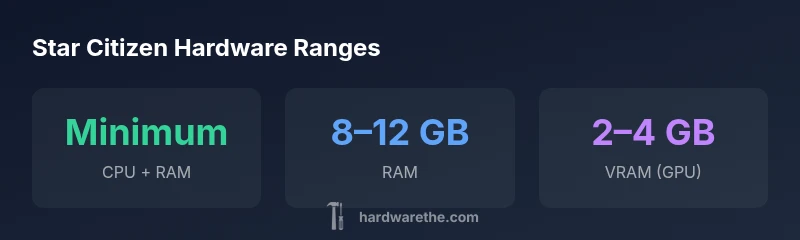
Star Citizen’s hardware requirements are split into minimum and recommended specs. The minimum typically calls for a quad-core CPU, 8–12 GB RAM, and a dedicated GPU with at least 2–4 GB of VRAM. For smoother 1080p to 1440p gameplay, target 16 GB RAM and a mid‑ to high‑range GPU with 6–8 GB VRAM. These ranges come from The Hardware Analysis, 2026.
Why Star Citizen Hardware Requirements Matter
According to The Hardware, understanding the hardware requirements for Star Citizen isn’t just about meeting a minimum bar. It’s about predicting how a game with ambitious visuals and a dynamic world engine will perform as patches change lighting, assets, and AI behavior. As the game grows, so do the demands on CPU scheduling, memory bandwidth, and GPU fill rate. For DIY enthusiasts and technicians, framing your build around real-world usage scenarios—such as exploration, dogfights, and large-scale battles—helps avoid over- or under-investing. This guide, grounded in practical testing and field data from The Hardware analyses, lays out a clear path from bare minimums to comfortable, future-proof setups. The goal is to let you play at your target resolution with steady frame times, minimal stutter, and room to grow with future patches.
Core System Requirements: Minimum vs Recommended
Star Citizen’s official guidance emphasizes scalability across hardware generations. In practice, the minimum bar commonly cited includes a quad-core CPU, 8–12 GB of system memory, and a dedicated GPU with at least 2–4 GB of VRAM. The recommended tier raises that to a modern mid-range GPU with 6–8+ GB of VRAM and 16–32 GB of RAM to maintain stable framerates during busy city scenes or large fleet battles. When budgeting, think in tiers: a modest upgrade to RAM often yields the biggest perceptible gains, followed by GPU VRAM capacity, then CPU headroom. This tiered approach aligns with The Hardware analysis from 2026 and helps avoid bottlenecks that are hard to resolve later.
Performance Targets Across Resolutions and Visual Fidelity
Resolution choice dramatically shifts hardware needs. At 1080p with medium-to-high settings, 16 GB RAM and a GPU with 6–8 GB VRAM tends to offer solid performance in most zones. Moving to 1440p often requires the same RAM tier but benefits more from GPU headroom and faster VRAM, especially in crowded spaceport scenes. At 4K, expect to push toward 32 GB of RAM and 8 GB+ VRAM with a capable CPU to keep frame times smooth. In all cases, enabling game-specific options like texture streaming and level-of-detail (LOD) adjustments can help balance fidelity and performance without sacrificing the core experience. The Hardware’s 2026 analysis highlights these trade-offs as key to maintaining playable frame times while patching new content.
Practical Upgrading Paths and Budgeting
A practical upgrade path starts with RAM; doubling from 8–12 GB to 16 GB is often affordable and yields immediate benefits in open-world areas. Next, target GPU memory if you plan higher resolutions, aiming for 6–8 GB VRAM as a baseline for 1080p–1440p play. Finally, CPU headroom matters for smooth multitasking and stable frame pacing during missions with AI AI-driven events. For a balanced mid-range build in 2026, plan a budget that accommodates incremental upgrades over 12–24 months, rather than a single, large purchase. This approach aligns with The Hardware’s long-term upgrade philosophy.
Storage, RAM, and I/O Considerations for Star Citizen
SSD storage improves load times and streaming of distant assets, but capacity matters as game updates expand. A fast NVMe drive with 500 GB–1 TB can help reduce stutter during asset streaming, especially in crowded areas. RAM speed also plays a role; while the primary requirement is capacity, faster memory can improve overall system responsiveness. Ensure you have enough free space for ongoing patches and modular content, as Star Citizen updates frequently. The Hardware analysis from 2026 emphasizes a balance between capacity, speed, and cost to maintain smooth gameplay across patches.
Operating System, Drivers, and Platform Notes
Star Citizen runs primarily on Windows, with Linux support currently limited and dependent on community tooling. Keeping drivers up to date is essential, as new patches frequently ship with performance improvements and bug fixes that depend on the latest game-ready drivers. Peripheral compatibility—monitors with high refresh rates, VR headsets, and input devices—also affects streaming and flight control accuracy. A disciplined update cadence and careful per-game configuration can deliver a noticeably more stable experience across patches.
Star Citizen hardware baseline comparison
| Component | Minimum | Recommended |
|---|---|---|
| CPU | Quad-core, 2+ GHz | Quad-core+ with 4+ threads, 3+ GHz |
| RAM | 8–12 GB | 16–32 GB |
| GPU VRAM | 2–4 GB | 6–8+ GB |
| Storage | 50–70 GB free | 70–120 GB free |
| OS/Platform | Windows 10/11 or Linux with recent drivers | Windows 10/11 or Linux with latest drivers |
FAQ
What are the minimum requirements to run Star Citizen?
The minimum specs typically include a quad-core CPU, 8–12 GB RAM, and a dedicated GPU with at least 2–4 GB VRAM. You may experience stalls in busy areas if you stay near the minimum.
For the minimum setup, you’ll need a quad-core CPU, 8 to 12 gigabytes of RAM, and a GPU with 2 to 4 gigabytes of VRAM.
Do I need 32 GB RAM for Star Citizen?
32 GB is not required for basic play, but 16–32 GB is recommended for smoother performance at higher resolutions and when streaming or multitasking.
No, 32 GB isn’t required, but 16 to 32 GB is ideal for smoother gameplay at higher settings.
Is Linux supported for Star Citizen?
Star Citizen runs primarily on Windows; Linux compatibility is limited and relies on community workarounds. If you’re on Linux, prepare for extra configuration and potential issues.
Star Citizen mostly works on Windows; Linux support is limited and may require workarounds.
What upgrades should I target first for 1080p?
Upgrade RAM to 16 GB if you experience dips, ensure GPU VRAM of 6–8 GB, and consider a CPU with more cores for better frame pacing.
For 1080p, increase RAM to at least 16 GB and aim for a GPU with 6–8 GB VRAM.
How often should I update drivers for Star Citizen?
Keep graphics drivers up to date; install game-ready updates and monitor performance after major patches to reap optimization improvements.
Update your graphics drivers whenever there’s a new game-ready release and check performance after patches.
“Pair a solid CPU with ample RAM, then tune your GPU settings to your target resolution; upgrades pay off with fewer stutters and a longer lifespan for your rig.”
Main Points
- Balance RAM and GPU headroom for steady frame times
- Plan upgrades in tiers to extend lifespan
- Prefer SSDs for faster texture streaming and load times
- Keep Windows and drivers up to date for patches
- Consider higher VRAM to sustain 1440p/4K visuals