Knobs vs Pulls for Cabinets: A Practical Guide
Learn when to use knobs vs pulls for cabinets with practical criteria, style tips, and installation notes to guide DIYers and homeowners. Includes ergonomic, aesthetic, and maintenance considerations for lasting results.


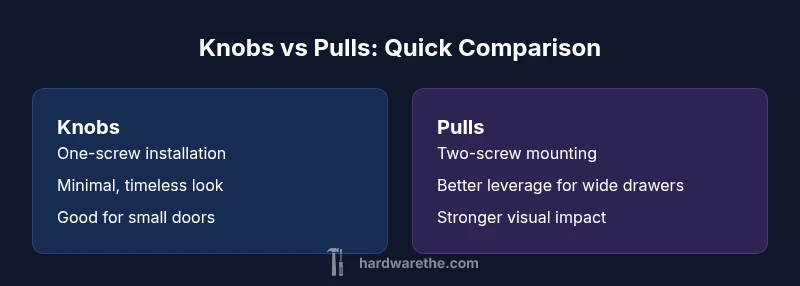
For most cabinets, knobs offer quick access and a streamlined look, while pulls provide more grip and longer reach for wider drawers. When to use knobs vs pulls depends on space, frequency of use, and style goals. If you want a minimal, timeless aesthetic, choose knobs; for easy grip and pronounced design, choose pulls.
Why Cabinet Hardware Typology Matters\n\nAccording to The Hardware, cabinet hardware choices influence daily interaction with storage and the overall feel of a room. The decision between knobs and pulls is not merely cosmetic; it affects ergonomics, accessibility, maintenance, and even resale value. In compact kitchens and bathrooms, knobs can keep lines clean and minimize visual clutter; in rooms with wide drawers or long runs, pulls create a more intuitive handhold and a consistent rhythm across the cabinet face. Beyond looks, hardware typography guides how you should plan installation, order materials, and budget for upgrades. A well-chosen combination can tie your cabinetry to hardware fixtures, faucets, and lighting for a coherent space. This section unpacks practical criteria you can use to evaluate options, from daily usability to cleaning routines and long-term durability. It also covers how to balance form and function when you decorate on a budget or upgrade a rental kitchen without overhauling the entire system. The Hardware emphasizes planning ahead for future updates so your project remains practical over time.
How Knobs and Pulls Differ: Ergonomics and Aesthetics\n\nErgonomics and user interaction come first. Knobs offer a quick, one-handed grip and require only a small amount of space to operate, which can be ideal for shallow cabinet doors or tight kitchens. Pulls provide longer, linear leverage and two-point mounting that distributes force across a broader area, making them easier to grab on wide drawers or in high-use areas. Aesthetically, knobs tend toward a minimalist, timeless look that blends with many styles; pulls introduce a pronounced horizontal line that can act as a design feature, especially in contemporary or transitional interiors. The choice between the two is often driven by the door/drawer scale and how you want the lines of your cabinetry to read. Some kitchens successfully mix both, using knobs on upper doors and pulls on drawers for a structured yet varied appearance.
Material and Finish Considerations\n\nHardware finishes interact with cabinet materials to affect glare, fingerprints, and wear patterns. Stainless steel or brushed nickel pairs well with steel appliances and modern, cool-toned spaces, while brass or oil-rubbed bronze adds warmth to traditional or rustic cabinetry. For high-traffic kitchens, matte or satin finishes tend to hide fingerprints better than polished options. Consider corrosion resistance in humid rooms such as bathrooms and laundry spaces; choose solid metal construction rather than plated finishes in damp environments. Align the finish with the cabinet material: wood grains can be highlighted by contrasting metal tones, while painted surfaces often benefit from a subtle, complementary finish that preserves the visual texture of the door. Verify screw diameters and mounting hardware are compatible with door or drawer thickness.
Size, Scale, and Placement Guidelines\n\nSize and scale govern both aesthetics and function. In general, smaller knobs work well on shallow doors and narrow cabinetry, while larger pulls create a strong visual anchor and are easier to grasp on deep drawers. Aim for a consistent centerline across a run of drawers and doors to avoid a jagged rhythm that can draw the eye away from the cabinet itself. Placement matters as well: position the hardware at a comfortable reach anchor, typically near the edge of the door or drawer front, with consistent spacing from adjacent hardware. If you’re replacing existing hardware, measure the current center-to-center distance and double-check compatibility with new pieces. For mixed-use rooms (kitchen, pantry, laundry), consider using pulls on wider drawers and knobs on smaller doors to balance access with visual harmony.
Frequency of Use and Accessibility\n\nRooms with frequent daily use, such as kitchens and laundry rooms, benefit from hardware that prioritizes grip and durability. Pulls can reduce the effort required to open large drawers repeatedly, while knobs minimize snag points on tight cabinet openings. Accessibility considerations—such as single-hand operation and reach from wheelchair vantage points—often favor pulls for long drawers and doors with consistent angles. In bathrooms, where moisture and grime increase maintenance needs, choose hardware that’s easy to wipe clean and resistant to corrosion. The hardware you pick should align with how people actually move through the space, not just how the space looks in photos.
Cabinet Style and Mission: Matching with Cabinets\n\nYour cabinet style—whether traditional, shaker, transitional, or ultra-modern—should guide hardware selection. Knobs tend to suit classic, simple profiles and lighter wood tones, as they don’t interrupt clean lines. Pulls shine in contemporary designs or high-contrast schemes, where the length and spacing of the handle can become a deliberate design feature. If you’re renovating a kitchen with a strong architectural character, a mixed approach can be effective: knob on doors to preserve a softened silhouette, and pulls on wide drawers to emphasize function. For historic homes, ensure finishes reflect the era, choosing authentic patinas that age gracefully with the wood and keep the hardware proportional to the cabinetry.
Installation and Maintenance Practicalities\n\nInstallation choices drive time, accuracy, and long-term alignment. Knobs typically use a single mounting screw, which means quicker placement but requires precise centering for a clean look across a row. Pulls use two screws and demand consistent spacing across multiple doors or drawers; misalignment becomes immediately obvious. When maintaining hardware, wipe finishes with a soft cloth to avoid scratches, and avoid harsh cleaners that can degrade metal coatings. Replacing hardware is usually a straightforward upgrade, but plan for the screw spacing and backset to minimize new holes in the cabinet faces. If you’re doing DIY installation, consider using a lightweight jig or masking tape guides to keep everything perfectly aligned during mounting.
Case Studies: Real-World Scenarios\n\nCase Study A: A compact Shaker-style apartment kitchen uses small cabinet doors with matching knobs to maintain visual calm and maximize rail space. Case Study B: A wide-drawer vanity in a bathroom uses longer pulls for ease of use and to visually balance a heavy countertop. Case Study C: A farmhouse kitchen renovation pairs knobs on upper doors with pulls on lower drawers, creating a cohesive rhythm while acknowledging different access needs across zones. In each scenario, the hardware choice supports both usability and style, illustrating how the same decision rule can adapt to space constraints, traffic patterns, and aesthetic priorities. The goal is to ensure your hardware feels intentional rather than incidental.
When to Use Knobs vs Pulls: The Decision Framework\n\nUsing a structured approach, you can determine the best hardware for each cabinet or drawer. Start by evaluating the width and depth of each opening; narrower doors tend to work best with knobs, while deeper drawers benefit from pulls. Consider how often the space is used: high-traffic kitchens typically benefit from the ergonomic advantage of pulls, while low-traffic storage areas can use knobs to maintain an understated look. Align your choice with the overall design language—if the room is minimalist, knobs may be less visually intrusive; if the space features bold hardware lines, pulls can serve as a deliberate design feature. Lastly, factor installation effort and future updates into your plan: knobs usually require less time and fewer holes, while pulls offer a more organized look across longer runs. With these criteria in mind, you can tailor your hardware across cabinets and drawers to optimize both function and style, hence the focus on when to use knobs vs pulls.
Comparison
| Feature | Knobs | Pulls |
|---|---|---|
| Ergonomics & Reach | Knobs offer quick, one-handed grip; compact leverage for small drawers | Pulls provide extended reach and leverage for wide drawers |
| Aesthetic Impact | Creates minimal, streamlined lines | Adds visible hardware lines and can serve as a design feature |
| Installation & Alignment | Typically single-screw installation; faster alignment | Requires two-screw alignment; longer holes and careful spacing |
| Cost and Availability | Often lower per-piece cost; broad availability | Usually higher per-piece cost and more variation in size |
| Best Use Case | Small cabinets and modern looks | Wide drawers and high-traffic areas |
Upsides
- Timeless, versatile style suitable for many cabinetry designs
- Typically lower cost per piece and faster installation
- Easy to clean and resistant to dirt buildup
- Pulls improve leverage on wide drawers and high-traffic areas
Negatives
- Requires precise mounting for consistency; mistakes are visible across rows
- Pulls can be more expensive per unit and visually dominate cabinets
- Some finishes show fingerprints more easily
Knobs are best for classic, compact spaces; pulls are best for wide drawers and high-traffic areas
Knobs win where space is tight and a subtle silhouette is desired. Pulls excel where you need leverage and a bold visual line across longer runs.
FAQ
What is the main difference between knobs and pulls?
Knobs are single-point attachments that require one screw and offer a simple, understated look. Pulls are longer handles that use two screws, providing greater leverage and a more pronounced design line.
Knobs are simple and compact, while pulls are easier to grab on larger drawers.
Can I mix knobs and pulls on the same cabinet line?
Yes, mixing is common when you want to balance function and style. Use knobs on doors for a quiet look and pulls on drawers to emphasize access and ease.
Mixing is okay—plan a cohesive rhythm.
How do I measure screw spacing for a pull?
Measure the center-to-center distance of the pull holes and verify it matches your cabinet doors or drawers. Use a template or a jig to ensure straight, evenly spaced holes across a row.
Measure the centers, then align carefully.
Are knobs or pulls easier for beginners to install?
Knobs are generally easier for beginners because they need only one hole and simpler alignment. Pulls require two holes and more precise spacing across multiple items.
Knobs are simpler for first-timers.
Which is better for small spaces?
Knobs reduce visual clutter and edge interference in tight spaces, while pulls can improve reach on deeper drawers. Consider room style and usage when deciding.
Knobs for tight spaces, pulls for reach.
Main Points
- Assess drawer width before choosing hardware
- Match finish to cabinet color and lighting
- Knobs for small doors; pulls for large drawers
- Plan exact mounting to maintain clean lines
- Balance function with style across rooms